 1 / 5
- 30 slots maximum
- 12 outfit formulas
- Fit checks first
- 74 printable pages
Men's capsule wardrobe · Guide and workbook
Close your wardrobe at thirty pieces
Ten tops, five bottoms, six layers, four shoes and five extras. Replace a worn piece in its slot. An eleventh top stays outside the list.
- Thirty named slots, each with a job you can say in one sentence
- Twelve formulas, F1 to F12, built only from those slots
- Fit checks in a fixed order, shoulder first, then a fault table
- A twelve-month audit, a ninety-day box, and five pieces if you are starting small
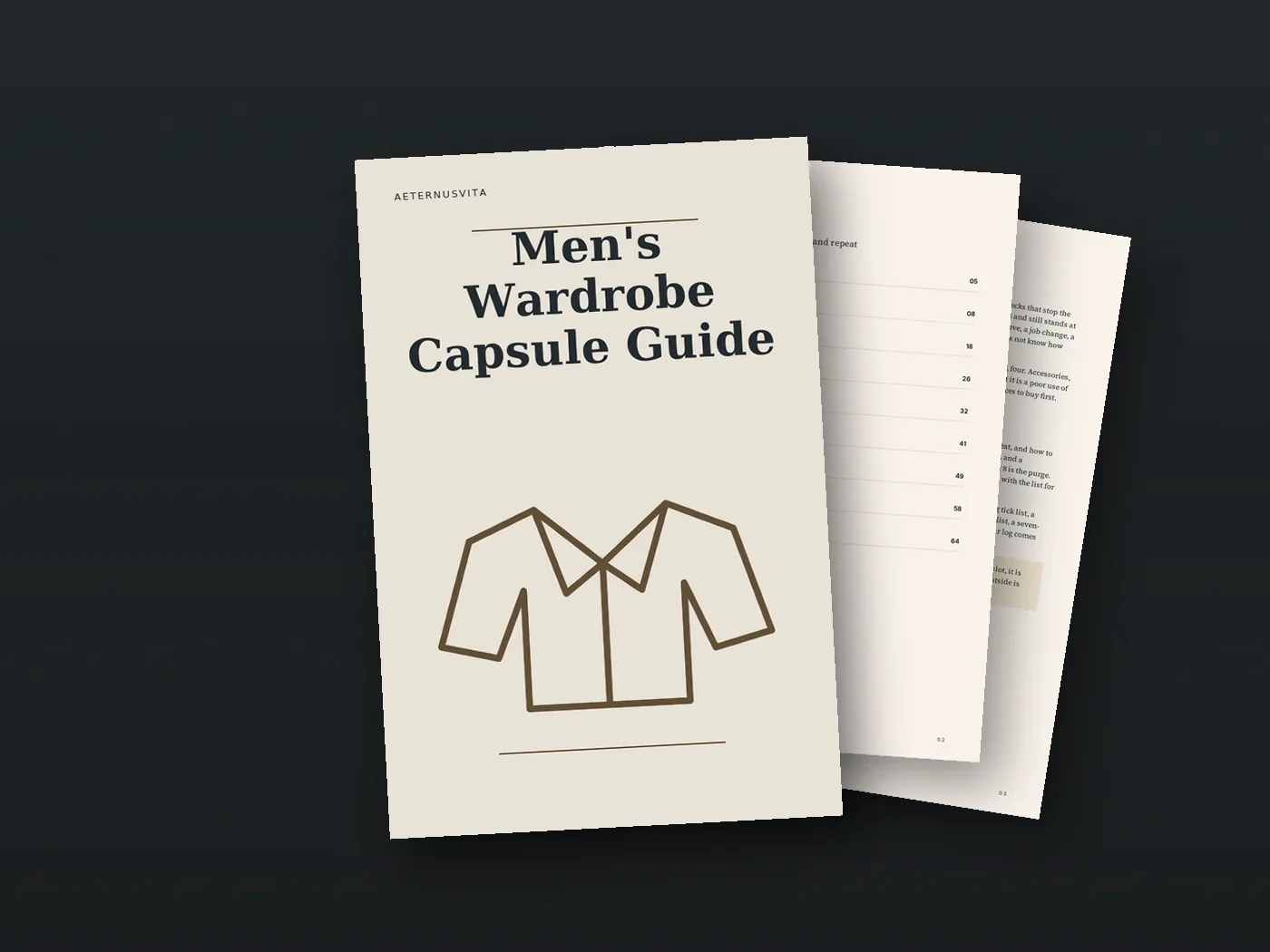
Men's Wardrobe Capsule Guide
£13
- +One combined book PDF (guide and workbook in a single file)
- +Instant download: PDF files you can print or use on a tablet
One-off payment. Download straight after checkout.
30-day refund. If it isn't useful, reply to your receipt within 30 days for a full refund.
Instant PDF Print or tablet Any device
What it is+
A closed list of thirty pieces for a man's ordinary week, plus the checks that stop the list turning back into a pile. It is written for someone who already owns clothes and still stands at the rail. It is also for someone replacing a wardrobe after a move, a job change, a separation, or a change in body.
What's inside+
Chapters 1 to 5 cover the rules, the slots, fit, colour and shopping by piece name. Chapters 6 to 9 cover formulas F1 to F12, care and the tailor, the audit, and travel. Worksheets cover fit notes, a palette card, your own budget line, formula rows and alteration quotes. Later sheets cover the audit, a packing list, a seven-day wear log and a ninety-day review.
How to use it+
Tick the slots you already own before you buy. If the rail is full, do the audit first, then one buying pass. If you own almost nothing, start with the five pieces named for a restart. Fill each worksheet when you reach it. The wear log comes after you have something to wear. The writing before a shop trip is timed on the page at 30 minutes.
Delivery and refunds+
After payment you download two PDFs, the full guide and the companion workbook. A ZIP holds those files with a README and a licence. 74 pages, set as A4, so the slot card can go to the shop. Refunds follow the policy shown at checkout.
Made for the morning you stand at the rail
You already own a full rail
You have enough clothes for the week, and the morning still starts with a guess. A sale still adds a top when nothing leaves. Each piece in the list has one job, and a new buy has to name the slot it replaces.
You are replacing a wardrobe
After a move, a job change, a separation, or a change in body. Five pieces are named as the first buy. The other slots wait until those five are being worn. An empty slot is written down as slot open.
One room needs a sharper outfit
Your week may include work, the weekend, the weather, and a dinner or meeting a navy blazer can carry. A job that needs a suit and tie keeps that suit outside this list. The blazer stays in the thirty.
The problem
The sale adds an eleventh top
You can already get through an ordinary week, and you still stand at the rail in the morning. A sale adds a top when you have not retired one. Spares move onto the rail, and thirty becomes fifty with nobody deciding. The rule that holds the number is one in, one out, same slot.
How it works
A list with a door on it
The ceiling is thirty, made up of ten tops, five bottoms, six layers, four shoes and five extras. Those slots cover work, the weekend, the weather, and one sharper room. A worn-out piece is replaced in its own slot. A colour changes when the palette sheet says so. An eleventh top, bought because a rail was reduced, stays outside. Chapter 6 writes formulas F1 to F12. Each one is top, bottom, layer and shoe, and every piece comes from the thirty. Where fewer formulas cover the four jobs, the sheet holds fewer.
This guide vs generic advice
The shoulder outranks the logo
You check the shoulder before anything else. Then you move to the collar, the chest and the waist, the seat, the sleeve and the hem. A seam that sits down the arm sends the jacket back. A hem that pools, or a waist that needs suppressing, is ordinary tailor work once the shoulder has passed. A tailor can move a hem. A tailor cannot give you a different shoulder.
Colour is a lane you repeat, chosen in daylight beside a window. Warm repeats earth, olive, warm navy and camel. Cool stays with true navy, charcoal, cool greys and burgundy. When the home checks disagree, the lane is neutral, and you keep to white, navy, grey and charcoal. Try camel or burgundy as one garment, in a slot you already have.
The seven-day wear log comes once you have something to wear. The ninety-day sheet is the second look. A bad morning is not a review. Leave the shop.
Fit before the cloth01
Five checks, shoulder first
The shoulder seam has to sit on the shoulder bone. A seam down the arm means the piece goes back. Collar, chest, seat, sleeve and hem come after that. Trousers are finished with the shoes you will wear with them. The hem rests lightly on the shoe, or it meets the shoe. Fabric that pools on the laces goes to the tailor. Athletic, lean and fuller are three worked try-ons of those same checks. Write what is true this year on the fit sheet. A fault table pairs what you see with return or tailor.
The formulas02
Top, bottom, layer, shoe
F1 to F12 are written out, and every piece in them comes from the thirty. A composite five-day week is labelled as an illustration. Two of the days are in a collar. One is a knit with jeans, one might get wet, and one might end in dinner. Your own sheet can hold fewer formulas when your week needs fewer. A quick card for a late morning narrows the choice to four decisions. White trainers stay with jeans and chinos. The charcoal trouser and the blazer take the loafers.
Audit and travel03
Twelve months, then the box
Keep what you wore in the last twelve months. The rest goes in a transition box, and it is donated at day ninety if it is still there. A restart begins with five pieces, then a later pass for the slots still open. A week away uses three lists of exactly ten pieces. One list is for mild weather, one for hot and one for cold. The mild list has a seven-day rotation written out. A packing checklist and one wear log follow.
As easy as it gets
Start from the clothes you already own.
1Step 1
Tick the thirty
A piece you already own that matches a row fills that row. A piece that fails a fit check leaves the row empty. The watch, the sunglasses and the athletic shoe can be ticked empty on purpose.
 2
Step 2
Write a ceiling
List the holes, then put one number next to this pass, in your currency. The book times that desk work at 30 minutes. When the number is spent, the slots still open wait for another pass.
 3
Step 3
Say the slot aloud
At the till the sentence is "This replaces the navy chinos." If the sentence needs "as well", the piece goes back. Book the tailor for a hem or a waist only where the shoulder already passed.
Timeline
What to expect
Worked try-ons and the sample week are illustrations. Fill the sheets in the order you meet them.
Tick the rail
Count the clothes you already own against the thirty slots. A failed fit check leaves that slot open for a later pass. The shop is a later chapter.
What's inside
- Chapter 1. Four jobs for the rail (work, weekend, weather, one sharper room) and the rules that hold the count at thirty
- Chapter 2. Slots 1 to 30, each with a default, a job, and the swap that stays inside the slot
- Chapter 3. Five fit checks, worked try-ons for athletic, lean and fuller builds, a fault table, and fit notes
- Chapter 4. Warm, cool and neutral colour lanes, combination rules, and a palette card
- Chapter 5. Budget, high street and full price, search words, one buying pass, and a tick list of the thirty
- Chapter 6. Formulas F1 to F12, a five-day week labelled as an illustration, and blank rows for your own
- Chapter 7. Care defaults, including hang-dry for knits, the sewn-in label as the override, the tailor visit, and six disappointments
- Chapter 8. Worn in the last twelve months, a transition box, donate at day ninety, and a five-piece restart
- Chapter 9. Lists of ten for mild, hot and cold, a seven-day mild rotation, one wear log and a ninety-day review
Preview the pages
Still have questions?
What if my work needs a suit?+
A job that needs a suit and tie keeps that suit outside the thirty. The sharper meeting in chapter 6 is one a navy blazer can carry, so the blazer stays in the list. The weekend uses the slots you already have, including the field jacket when the weather asks for it.
Do I have to buy all thirty?+
Thirty is a ceiling. Buying all thirty in a fortnight is called a poor use of the audit. If you own almost nothing, you begin with five named pieces. The other slots wait until those five are being worn.
Which brands should I buy?+
Shops are left blank on purpose, and you write the ones you will use. Search the piece itself, such as navy unstructured blazer or dark straight jeans. The alteration line stays blank until a tailor gives you a figure.
What sits outside the thirty?+
Shorts, swim kit, hi-vis workwear and pyjamas sit outside. So do socks, underwear, black-tie kit, a work uniform and garden shoes. One athletic shoe is inside, so a run leaves the white trainers clean. If you do not train, that slot can stay empty.
Do I need a printer?+
The thirty-slot card is written to take into the shop, and the worksheets are written for a pen. You receive PDFs, 74 pages, laid out for A4.
How do I receive it?+
You get an instant download after payment. That download is one combined book PDF (guide and workbook in a single file), inside a ZIP with a README and a licence. Refunds follow the policy shown at checkout.
Instant PDF download · 74 pages · Print the shop card
Educational only. This is a style and shopping guide. Budgets, bodies and dress codes differ, and the book reports no one's result. Written with AI assistance, reviewed by AeternusVita.
Men's Wardrobe Capsule Guide