
2026-10-30 · 3 min read
Should Therapists Use AI Prompts for Documentation?
If you spend your evenings finishing progress notes, you are not alone. Documentation eats hours every week for many clinicians, and the question comes…
By AeternusVita
We make the products recommended here.
If you spend your evenings finishing progress notes, you are not alone. Documentation eats hours every week for many clinicians, and the question comes up more and more: should therapists actually use AI tools to help with paperwork? The short answer is that AI can be a useful drafting assistant — as long as protected health information never goes into the tool and a licensed clinician reviews everything before it enters the record.
This post walks through the real pros and cons, the privacy rules that matter, and how to decide whether AI-assisted documentation fits your practice.
The case for using AI on paperwork
Most therapists did not enter the field to write treatment plans at 9 p.m. The administrative load — progress notes, homework sheets, psychoeducation handouts, discharge summaries — is one of the biggest drivers of clinician burnout. An AI drafting assistant can turn a rough outline into a structured first draft in seconds, which you then edit, correct, and approve.
The key mindset shift: the tool drafts, you decide. Nothing AI-generated should go into a client file unreviewed. Used that way, prompting help can shrink the pile of after-hours admin and give you back time for clients — or for leaving work at work.

The privacy line you must not cross
Here is the non-negotiable rule: never paste protected health information (PHI) — names, dates of birth, session details that identify a client — into any AI tool that is not HIPAA-compliant. Most general-purpose chatbots are not.
Safe practice means de-identifying first: strip identifiers, work with fictionalized or composite examples, and keep prompts about structure, wording, and format rather than about a real person. A good prompt library builds this in, with a de-identification checklist you run before every prompt and reminders at the point of use.
What to look for in therapy prompts
Not all prompts are equal. Prompts written for clinical documentation should:
- Ask for structure, not conclusions — outlines and phrasing you fill in and verify.
- Fence off risky uses — for example, framing differential-diagnosis prompts as thinking aids, never diagnostic tools.
- Include an ethics frame — when AI use is appropriate, what to disclose, and where human review is required.
- Cover the full workflow — intake summaries, treatment plans, progress notes, homework, psychoeducation, discharge.
Generic "write me a progress note" prompts off the internet rarely include any of this. Purpose-built prompts do.
The objection: "Isn't this unethical or impersonal?"
It is a fair concern. The answer depends entirely on how you use it. Having AI format your outline into a readable note that you review and sign is no more impersonal than using a template or dictation software. What would be unethical is letting unverified AI text stand as your clinical judgment, or exposing client data to do it.
Think of it like a calculator for your paperwork: it handles the tedious formatting so your judgment goes where it matters — accuracy, clinical nuance, and the client in front of you.
How this book helps
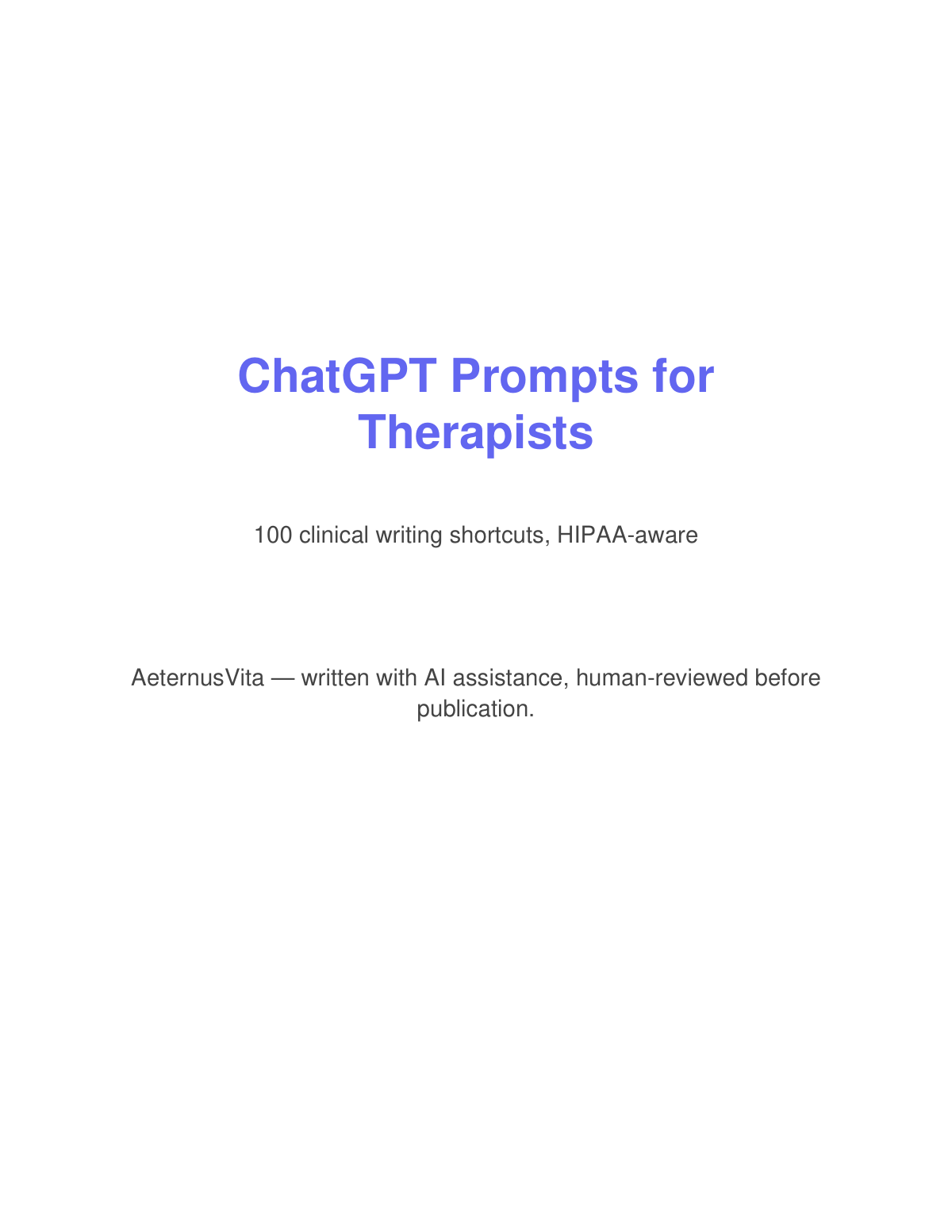
ChatGPT Prompts for Therapists (available here) gives you 100 prompts covering treatment plans, progress notes, psychoeducation, homework, and discharge summaries, each reviewed against a de-identification checklist, plus a de-identification guide for safer prompting and an ethics primer. An included time log lets you track your own documentation hours so you can see the difference yourself.
If your own workload has tipped toward burnout, readers also pick up the Burnout Recovery Pathway, a structured 8-week workbook for rebuilding energy and boundaries. And if anxiety spikes between sessions — yours or your clients' — the Anti-Anxiety Affirmation Card Deck offers 60 short cards in plain language for difficult moments.
Educational content only. Never paste PHI into non-HIPAA-compliant tools; always review AI-assisted drafts before filing.
Related articles
2026-11-01 · 3 min read
How to De-Identify Client Notes Before Using AI (A Step-by-Step Guide)
The single most important skill for any therapist using AI is de-identification: removing protected health information from your input before it ever…
Read article →2026-10-31 · 3 min read
How a Prompt Library Cuts Therapy Admin Time Without Cutting Corners
Ask a group of therapists what they would change about their week and documentation comes up fast. Notes, plans, letters, handouts — the paperwork…
Read article →2027-01-28 · 3 min read
Should Wedding Planners Use AI Prompts? An Honest Breakdown
Wedding planners live in their inboxes: client questionnaires, vendor follow-ups, timeline revisions, review requests, and the 11pm "quick question"…
Read article →