 1 / 5
- 50 numbered designs
- Rule them or type
- 4×6 and 5×7 cards
- Binder, tags, index
Workbook · Rule, type, print and bind
Keep the cook's words on a card you can reprint
You already have the recipes. Fifty designs to rule or type, in 4×6 or 5×7. Dividers, a binder cover, gift tags and a print guide are in the book too.
- The notes line on every card holds a story or a substitution
- Each design states the layout, the border, a colour target and one extra line
- Trim sizes in millimetres, a 3 mm bleed, crop marks and a 100% scale check
- Six dividers, a cover you measure yourself, a 12-row index and gift tags
Cottagecore Recipe Cards
£7
- +One combined book PDF (guide and workbook in a single file)
- +Instant download: PDF files you can print or use on a tablet
One-off payment. Download straight after checkout.
30-day refund. If it isn't useful, reply to your receipt within 30 days for a full refund.
Instant PDF Print or tablet Any device
What it is+
A workbook for recipes you already have. Fifty numbered designs tell you the layout, the border, a colour to aim at and one extra line. You rule them in ink, or you copy the field order in Chapter 4 into any editor. That typed page is the fillable version. Card sizes are 4×6 and 5×7. Dividers, a cover, a spine, an index and gift tags follow.
What's inside+
Eight chapters run from your first five recipes to a reprint log. A practice apple crumble shows every field on Design 04. Your own dishes replace every fact on that teaching card.
How to use it+
Work the chapters in order once. Spend about twenty minutes capturing one recipe, then rule or type one card. Print a single test at 100% scale before any batch. After that, keep the design tables and the counter card nearby. The first win the book is built around is one finished card.
Delivery and refunds+
Instant PDF download after payment. The ZIP holds the guide PDF, the workbook PDF, a README and a licence. Refunds follow the policy shown at checkout.
Made for recipes that live in one place

The only copy is getting tired
The dish is on a stained card, in a notebook, or only in someone's memory. The workbook is built so you can file a fresh card and keep a typed master outside the kitchen.

A gift leaves the house soon
Chapter 7 builds a bundle of 10 to 15 of your recipes, plus two or three blank cards. The blanks leave room for the next cook's own dish. Tags and kitchen twine finish the parcel. A bridal shower and a Tuesday with no audience use the same hand-over list.

The working card lives by the hob
One recipe sits on one card. A splash means you reprint that recipe from the typed master, and the rest of the binder stays put. The counter card tells you to sleeve it only after the ink is dry.
The problem
A pretty border cannot save tidied words
You already have the recipes. One of them may be a stained card, and another may live only in a person's memory. Chapter 1 asks you to keep the home name. A pinch stays a pinch, and 'until it looks right' stays in the cook's words.

How it works
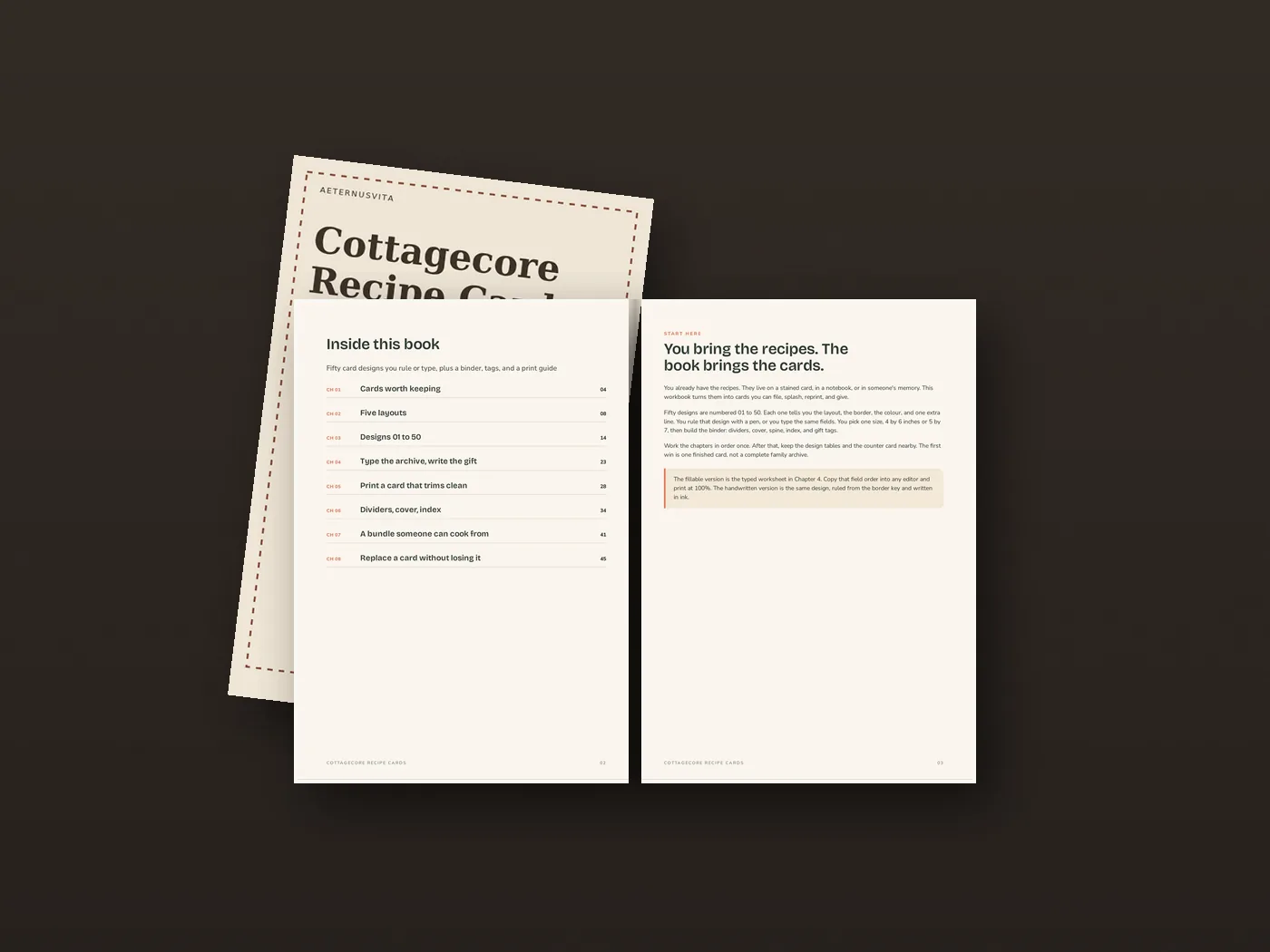
You bring the recipes. The book brings the cards.
Designs numbered 01 to 50 tell you where the words sit and which border to draw. Each one also names a colour to aim at and one extra line. You rule that design with a pen, or you type the same fields into any editor. Pick a single size, 4×6 or 5×7, and one orientation for the binder. Work the chapters in order once. The win the book is built around is one finished card.
This workbook vs generic recipe-card advice
Write the recipe before you draw the border
Every design carries the same eight fields. They are the name used at the table, who taught it, prep, cook, servings, ingredients, numbered steps, and a notes line. Leave the year blank unless you know it. Put ingredients in the order hands reach for them. The notes line carries the story or a substitution. A card with only weights is a reminder for someone who already knows the dish. The sample line in the book is 'taught by my grandmother, 1987'. You swap in a real person and year.
Classic split is the everyday card, with ingredients left of a vertical rule and steps on the right. Story keeper gives the bottom third to a story box when the telling is the point. The method still has to fit in five or six lines. A bake goes on Baker's ticket, which opens with tin, oven, time and rest. Weeknight strip stops at eight ingredients and six steps. One more step means the dish belongs on Classic split. Jar and shelf leaves the keep line for a tested source you can name. With no source to name, the line says the jar lives in the fridge and gets used.
Chapter 3 asks you to choose at most three designs and repeat them. A binder that uses every border looks like a sample book. The ten borders are Meadow, Buttercup, Rosehip, Linen, Orchard, Hearth, Pantry, Windowsill, Kitchen twine and Heirloom. Hex figures are targets. A coloured pencil that is close still counts when the frame and the extra line are right.
Designs 01 to 5001
Ten borders, then three you repeat
Each number pairs one of five layouts with a border and an extra line. That line might name who taught the dish, or what you serve beside it. You repeat at most three numbers in the binder you are making. The tables still name a job for every design you leave out. The first card you rule is Design 04, Linen, on scrap. A practice apple crumble fills that card so you can see every field. Home printers will not hit the hex colours exactly. A coloured pencil that is close still counts.

The print guide02
Measure one card before the batch
Portrait 4×6 trims to 101.6 by 152.4 mm. Portrait 5×7 trims to 127 by 177.8 mm. Bleed is 3 mm of colour past the cut, and crop marks sit in the margin. Print one card at 100% scale and measure it. Fit to page shrinks a 4×6 until it will not match the pocket you bought. The book treats 176 gsm as a floor and leaves the weight to what your printer will feed. A shop brief is there for when someone else cuts the cards.
Binder and gifts03
Six tabs, then a bundle of your own
Loose cards return to the drawer they escaped from. The six starter tabs are appetizers, mains, baking, desserts, drinks and preserves. You letter the word you say at home. Measure the clear pocket on your binder, then take about 4 mm off the height and the width so the cover slides in. A US letter pocket and an A4 pocket are different rectangles. A gift bundle is 10 to 15 filled cards plus two or three blanks, tied with kitchen twine. Tags are about 50 mm by 90 mm.

As easy as it gets
One capture, then one measured card.
 1
Step 1
Capture the voice
About twenty minutes with the old card, the notebook, or the person who cooks the dish. Stop when the time ends, even if the wording is clumsy.
2Step 2
Rule or type the card
Draw the design on scrap first, or copy the field order in Chapter 4 into any editor. Stop at that layout's line budget.
3Step 3
Measure, then file
Print one card at 100% scale and measure the trim. Sleeve it after the ink is dry. Keep a second copy of the master outside the kitchen.
Timeline
What to expect
Kitchens and printers differ. Here is how the book is designed to be used.
Five names, one capture
The worksheet asks for five dishes you can reach this month. One capture sitting is about twenty minutes. The book tells you to stop when the time ends, and to leave a second recipe for another day.
What's inside
- Chapter 1. Cards worth keeping: eight fields, a twenty-minute capture, and the first five recipes
- Chapter 2. Five layouts: line budgets, a practice apple crumble, and ruling Design 04 by hand
- Chapter 3. Designs 01 to 50: ten borders, a job for each number, and at most three you repeat
- Chapter 4. Type the archive, write the gift: a field order for any editor, then the same card in ink
- Chapter 5. Print a card that trims clean: sizes, 3 mm bleed, a test print, and a shop brief
- Chapter 6. Dividers, cover, index: six tabs, a cover you measure, and 12 index rows
- Chapter 7. A bundle someone can cook from: 10 to 15 cards, three gift tags, and a hand-over list
- Chapter 8. Replace a card without losing it: a reprint log, counter rules, and a weekend plan
Preview the pages
Still have questions?
Do I have to bring my own recipes?+
Yes. This is a print-and-paper workbook for recipes you supply. One apple crumble is printed in full as the teaching card for Design 04. It is marked as a practice fill. If you cook it, check your own oven. The book says to start looking at 30 minutes.
Are the 50 designs ready-made art files?+
They are specs you rule or type. Each number gives a layout, a border, a colour to aim at, and one extra line. The fillable page is the Chapter 4 worksheet. Copy that field order into any editor and print at 100%. Separate illustration files and digital form fields are not in this download.
What size are the cards?+
Two trims. Portrait 4×6 is 101.6 mm by 152.4 mm. Portrait 5×7 is 127 mm by 177.8 mm. A sideways card swaps those measurements. The book asks for one size and one orientation in a binder. A 4×6 fits pockets sold as 6×4 photo refills when you can read the card with the pocket the right way up. A 5×7 usually needs its own sleeve, a box, or photo corners.
Do I need 50 recipes before I start?+
The book says five loved cards will teach you the system. A plan for fifty recipes, with none written, teaches you nothing. You choose at most three designs and repeat them. The first win it is built for is one finished card.
Is this food-safety or medical advice?+
It is educational craft guidance. The keep line has to come from a tested source you can name, because shelf life and processing time stay with that source. If the source is missing, write that the jar lives in the fridge and gets used. An allergen on the notes line is a kindness on paper. That note is not a medical check.
How do I get it, and what about refunds?+
You get an instant download after payment. The ZIP holds the guide PDF, the workbook PDF, a README and a licence. The book is 50 pages. It is for personal use, and it asks you not to resell or redistribute the book or the designs. Refunds follow the policy shown at checkout.
Instant PDF download · 50 pages · Print, or rule by hand
Educational craft guidance only. This book is not food-safety advice, medical advice, or legal advice. It promises no heirloom outcome and no particular result from a printer or a shop. Written with AI assistance, reviewed by AeternusVita.
Cottagecore Recipe Cards