 1 / 5
- 2, 5 or 10 minutes
- Safety page included
- 21-day combined log
- Printable checklists
For long screen days · Guide + workbook
Neck and eyes share a 10-minute reset
The Day 1 Desk Reset covers neck, shoulders and eyes in the chair you already use. A short day uses the 5-minute midday cut or the 2-minute version at the end of a call.
- The Day 1 Desk Reset, timed from minute 0 to minute 10
- A 5-minute midday cut and a 2-minute version for the end of a call
- A tension and eye-strain self-assessment with scoring rules
- Desk checklist, 14-day calendar and 21-day log
Desk & Screen Reset Protocol
£15
- +Eight-chapter guide, opening with the Day 1 reset
- +Workbook pages in the same PDF, including the 21-day log
- +Quick cards to keep by the keyboard
One-off payment. Download straight after checkout.
30-day refund. If it isn't useful, reply to your receipt within 30 days for a full refund.
Instant PDF Print or tablet Any device
What it is+
A guide and workbook for adults who sit at a screen. One 10-minute session covers the neck, the shoulders and the eyes. Busier days use the 5-minute and 2-minute versions. The patterns and the log are for planning a desk habit.
What's inside+
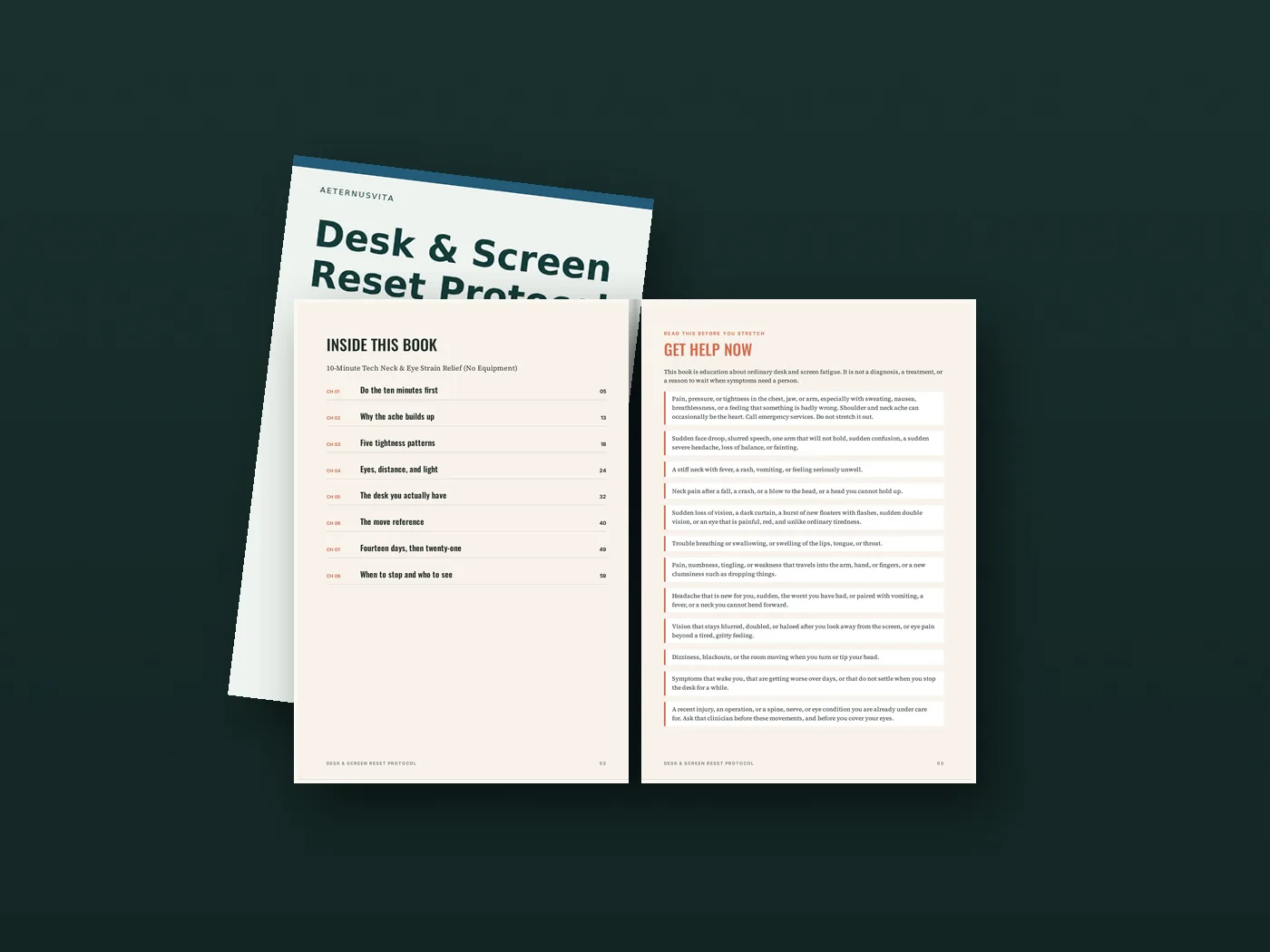
Eight chapters: the Day 1 reset, why the ache builds, five tightness patterns, eyes and light, the desk you have, the move reference, a 14-day calendar with a 21-day log, and when to stop. The quick cards are in the same PDF.
How to use it+
Read the safety page first. Do the ten minutes once and write a line. From day 4, add the 2-minute session at a moment you already have, such as the end of a meeting. From day 8, add one short pattern add-on and one desk change. Keep the log through day 21.
Delivery and refunds+
Instant PDF download after payment. Print the cards and the log, or read on a phone, tablet or computer. Refunds follow the policy shown at checkout.
Made for the day that shows up in your neck and your eyes
Your shoulders stay up after the call
Remote and office work keeps you in one chair for most of the day. The reset runs in that chair, with the work still open. Use the 10-minute session or a shorter cut.
Your eyes are slow to look up
Long near work, common for developers and designers, keeps focus at one distance. Chapter 4 times a 20-second far look and five full blinks. Blur that stays after you look away is a reason to book an eye test.
A laptop is the whole desk
Students and gamers often work where the screen and the keyboard are one object. Raise it on a book you already own, and stop at the height where your shoulders stay down. The same pages cover a kitchen table and a hot desk.
The problem
Two tissues, one long still day
The neck and the tops of the shoulders feel braced, and the eyes feel dry or slow to clear when you look up. This book uses tech neck as a shorthand for a chin towards the screen. It is not a diagnosis. A stretch after you log off meets both at once. The calendar puts a 2-minute pause in the working day and keeps the 10-minute reset.
How it works
Ten minutes, then one written line
You do the Day 1 sequence before the theory, in the chair you are already using. Ten minutes cover a far gaze, moves for the neck and shoulders, and a line you write at the end. The eye pause and the shoulder press each have stop rules on those pages. Shorter days use the 5-minute midday cut or the 2-minute version at the end of a call.
This guide vs generic desk advice
Why the neck and the eyes share a clock
The neck and the eyes do different work, and they share the chair. Day 1 gives each a turn inside the same ten minutes.
From day 8, the pattern with the most yes answers picks a 30 to 45 second add-on. Numbness and pain that travels belong on the safety page.
Chapter 2 teaches the longer lever. A chin towards a low screen moves the head out in front of the spine. The neck muscles then hold it on a longer lever. This edition leaves pound charts out. There is no source page a reader can check, and the popular charts disagree.
Start here01
Do the ten minutes first
The first session uses the chair you are already in. You note the eyes, the neck and shoulders, and any pressure at the base of the skull. At minute ten you note them again. One session is a trial. An invented kitchen-table note shows what a line looks like. The book is clear that this desk is made up.
Eyes and light02
Time the full 20 seconds
About every 20 minutes, look about 6 metres away for a full 20 seconds, then blink five times so the lids meet. In a small room, use the farthest real point and keep the chin level. If you already own blue-light glasses, you can keep wearing them. The book makes no claim that they reduce strain. The repeated steps are the timed look and the five blinks.
Days 8 to 2103
One add-on, then one desk change
Days 1 to 7 teach the same reset, whichever pattern you tick. From day 8, the pattern with the most yes answers adds 30 to 45 seconds. You change one thing on the desk. Three log sheets run through day 21. A flat or worse week is a reason to get checked. The chapter shows you how to read the sheets.
As easy as it gets
Safety page, one session, then the log.
 1
Step 1
Read page 3, then sit
The safety page lists stop rules and who to call. If those apply, you skip the trial. Otherwise you do the ten minutes once and keep the note.
 2
Step 2
Add the short break
From day 4, the 2-minute session fits the end of a meeting. You look at a far point, blink five times, tuck the chin, and squeeze the shoulder blades. On camera, the ranges stay small.
3Step 3
Fill the 21-day log
Mark the session length, how the neck and eyes felt, and headache yes or no. Ordinary mornings use a personal 1 to 10. Rescore the pattern on day 14 if the desk has changed.
Timeline
What to expect
The worked desks in the book are invented. This is how the pages are meant to be used.
Run one trial
Do the 10-minute reset and write a line. A flat recheck is a complete note. Sharp pain or a visual change sends you back to the safety page.
What's inside
- Chapter 1: the Day 1 Desk Reset, minute by minute, and how to write the recheck
- Chapter 2: why a still screen day loads the neck and the eyes, taught as a longer lever
- Chapter 3: five tightness patterns and the yes/no self-assessment, with scoring rules
- Chapter 4: 20-20-20 on a timer, the 2-minute session, distance, glare, and a plain blue-light page
- Chapter 5: the desk checklist, a trigger audit, and one change at a time
- Chapter 6: move reference, tender-spot limits, and the 5-minute midday session
- Chapter 7: the 14-day calendar, the 21-day log, and how to read a flat week
- Chapter 8: when to stop, and who to see
Preview the pages
Still have questions?
Is this medical treatment?+
No. These pages teach stretching, posture, screen habits and ordinary desk fatigue. They do not diagnose or treat. Radiating pain, numbness, a recent injury, or vision that persists needs a physiotherapist, a GP or an optometrist before you start. In the UK, call 999 for an emergency and NHS 111 for urgent advice that is not an emergency. Elsewhere, use your local emergency number.
Does this replace an eye test?+
Book a test if the letters look soft, or if you do not know the date of your last one. Screen height and a fortnight of blink breaks cannot stand in for a prescription.
What if the ten minutes feel the same, or a move hurts?+
Write a flat recheck down. One session is a trial, and the book treats that line as a finished note. Stop if the stretch turns sharp, if you feel dizzy, if your vision changes, or if symptoms spread. A mild stretch that eases when you let go is the only sensation the book is aiming at. The safety page forbids cracking the neck, letting anyone push it, and pressing on the eyes or the throat.
What do I need at the desk?+
A chair that does not roll away while you turn, and somewhere farther than the screen to look. A later tweak can use a sturdy book, a ream of paper, or a rolled towel you already have. A separate keyboard is for people who already have one. Glasses and contact lenses stay on unless your prescriber has said otherwise for screen work.
What if I am on calls, or the room is small?+
Use the farthest real point you have. The 2-minute session has a silent version with smaller ranges, so you can stay in frame. If you are presenting slides, do the blinks and the chin tucks between sections, and one full far gaze at the first pause.
Who should skip the trial?+
The programme is written for adults. Under 18, persistent neck or eye symptoms need a parent or carer and a clinician. If you are pregnant, a new headache, a visual change, or sudden swelling needs urgent maternity or medical advice. If you are already under care for a spine, nerve or eye condition, ask that clinician before these movements. Do the same in the weeks after an injury or an operation.
How do I get it?+
You get an instant download after payment. It is one PDF of 64 pages, with the guide and the workbook pages together. Print the cards and the log, or read on a phone, tablet or computer. Refunds follow the policy shown at checkout.
Instant PDF download · 64 pages · Print or read on screen
Educational only. This book is not medical advice and does not diagnose or treat. Written with AI assistance, reviewed by AeternusVita.
Desk & Screen Reset Protocol — 10-Minute Tech Neck & Eye Strain Relief (No Equipment)