 1 / 5
- 10 minutes apart
- Zero-based budget
- Sinking fund planner
- Five talk scripts
Couples money · Guide and workbook
Each of you writes a money story.
You each take ten minutes in private, then exchange one answer. Later chapters cover accounts and a joint budget from your statements. Debt, sinking funds and conversation scripts follow.
- Ten minutes apart on paper, before you compare a single answer
- Joint, separate or hybrid accounts, then a three-month review
- A zero-based budget filled from take-home pay and statements
- Monthly debt review, with a sinking-fund line for irregular bills
Money & Marriage: The Couples Financial Goals Workbook
£15
- +One 60-page PDF, with the guide and the worksheets together
- +Five chapters, each with a checklist and an action card
- +Budget grid, debt table, sinking-fund planner and goal pages
One-off payment. Download the ZIP after checkout.
30-day refund. If it isn't useful, reply to your receipt within 30 days for a full refund.
Instant PDF Print or tablet Any device
What it is+
A practical guide and workbook for couples. Each of you writes a money story in private. You then choose how accounts work and build a joint budget from statements. Debts, sinking funds and short scripts for the harder talks come after that.
What's inside+
Five chapters. Each one has a worked example, a worksheet, a checklist and an action card. The same file holds a zero-based budget grid, a debt table and a twelve-category sinking-fund planner. Goal pages cover one, five and ten years, alongside five conversation scripts.
How to use it+
Read the scope notes and choose one chapter to begin. Follow the worked example, enter your own facts and keep the action card with the task. Leave a blank where you are unsure, and name who will check it. Local rules and professional advice take priority over a general printable.
Delivery and refunds+
Instant PDF download after payment. The ZIP contains one 60-page PDF, guide and worksheets together, plus a README. Refunds follow the policy shown at checkout.
Made for two histories and one set of bills

Engaged, and the accounts are still open
You are about to share rent, food or a home, and joint, separate or hybrid is still undecided. Four questions cover who sees the balances, unequal incomes, debt that changes liability, and the privacy each of you keeps. You write the reason and a three-month review.

Newly wed, and the budget is still verbal
The rent gets paid. What happens to the rest has not been written down. The budget chapter asks what income is certain this month, which bills fall before payday, where the margin sits, and which category needs a cap.

The same pot means two different things
One of you wants a cash reserve. The other wants shared experiences funded on purpose. Chapter 1 has you each write for ten minutes before you compare. The worked example gives both needs a name and a line in the budget.
The problem
The same balance means two different things
A larger balance can feel like safety to one of you, and like money for time together to the other. A surprise charge or a tight week then drags in choices that were never written down. This workbook starts with both histories, before the budget grid opens.


How it works
Finish the chapter with a dated next step
Read the scope notes first. Then take one chapter: the decision, a worked example, your own facts, a checklist and an action card. Date any choice that might change. If a number is missing, leave the cell blank and name who will confirm it. Stop where the next step depends on local law or a contract, and ask a qualified professional.
This workbook vs generic money advice
Why the first ten minutes are on paper
Each partner writes alone before anyone has to reply. The prompts ask what money meant growing up, what feels urgent now, which expense feels worthwhile, and what would make the talk feel safe. You exchange one answer and repeat what you heard. Then you name one shared value and park what is still open.
You date the choice and name who carries the next action. Unknown figures stay blank until someone can confirm them. When something changes, you cross out the old line, write the reason and date the new one.
The working budget is the zero-based grid, filled from statements, with debt minimums listed before any extra payment. A 50/30/20 split sits beside it as a discussion aid. Extra payments can follow the smallest balance or the highest interest, and a checklist brings that choice back each month.

Money stories01
Ten minutes apart, then one shared value
Each partner writes alone for ten minutes. You swap one answer and repeat what you heard, then name one shared value and park the rest. The worked example names a cash reserve and shared experiences, then budgets for both. The action card asks for the first prompt and the first checklist tick before you move on. Where secrecy, coercion or fear is involved, the card points you to qualified support.

Budget, debt, sinking funds02
Give every remainder a job
Start with take-home income and your statements. Bills, savings and debt minimums each get a line, and whatever is left needs a job. If the plan is already past income, go back to the flexible categories. A 50/30/20 table sits beside the grid for comparison. The book says that split is unsuitable for some households. Enter essential bills at the figure on the statement. One illustration uses a combined take-home of three thousand pounds, with one hundred and fifty pounds still to assign. Another shows a three-hundred-pound annual bill, twelve months out, as a twenty-five-pound monthly sinking-fund line, once the real due date is checked. You replace the samples with your own figures. Pay minimums before any snowball or interest-first extra, then review that choice monthly. The net-worth snapshot is a household record of assets and liabilities.

Goals and money dates03
A money date with a pause rule
Each goal page asks for the amount, how you estimated it, a target date and a first action with an owner. You each write a preference, then rank one-year, five-year and ten-year pages. Where you differ, both views stay and you choose one small step you can share. The book calls the date a planning target. A money date is a short review of facts and feelings, with a pause when the talk heats up. Five conversation scripts give you an opening. The surprise-purchase sample names the worry and asks you to agree what size of charge needs a check-in. Pause if either of you feels unsafe.
As easy as it gets
One chapter at a time.
1Step 1
Write for ten minutes
Each of you writes in private about what money meant growing up and what feels urgent now. Exchange one answer when the ten minutes are up.
 2
Step 2
Enter the statements
Use a record you can point to for shared bills, take-home income or a sinking-fund due date. If a cell cannot be verified, leave it blank.
 3
Step 3
Date the next action
Name the owner and the review date. Note anything still missing, and park the decision you cannot settle today. Keep the action card with that job.
Timeline
What to expect
Households differ. These stages describe how the book is designed to be used.
Scope notes, then ten minutes
Read the safety and scope notes, then choose one chapter. If you start with money stories, you each write for ten minutes and exchange one answer. The worksheet tells you to leave a blank when you do not know yet.
What's inside
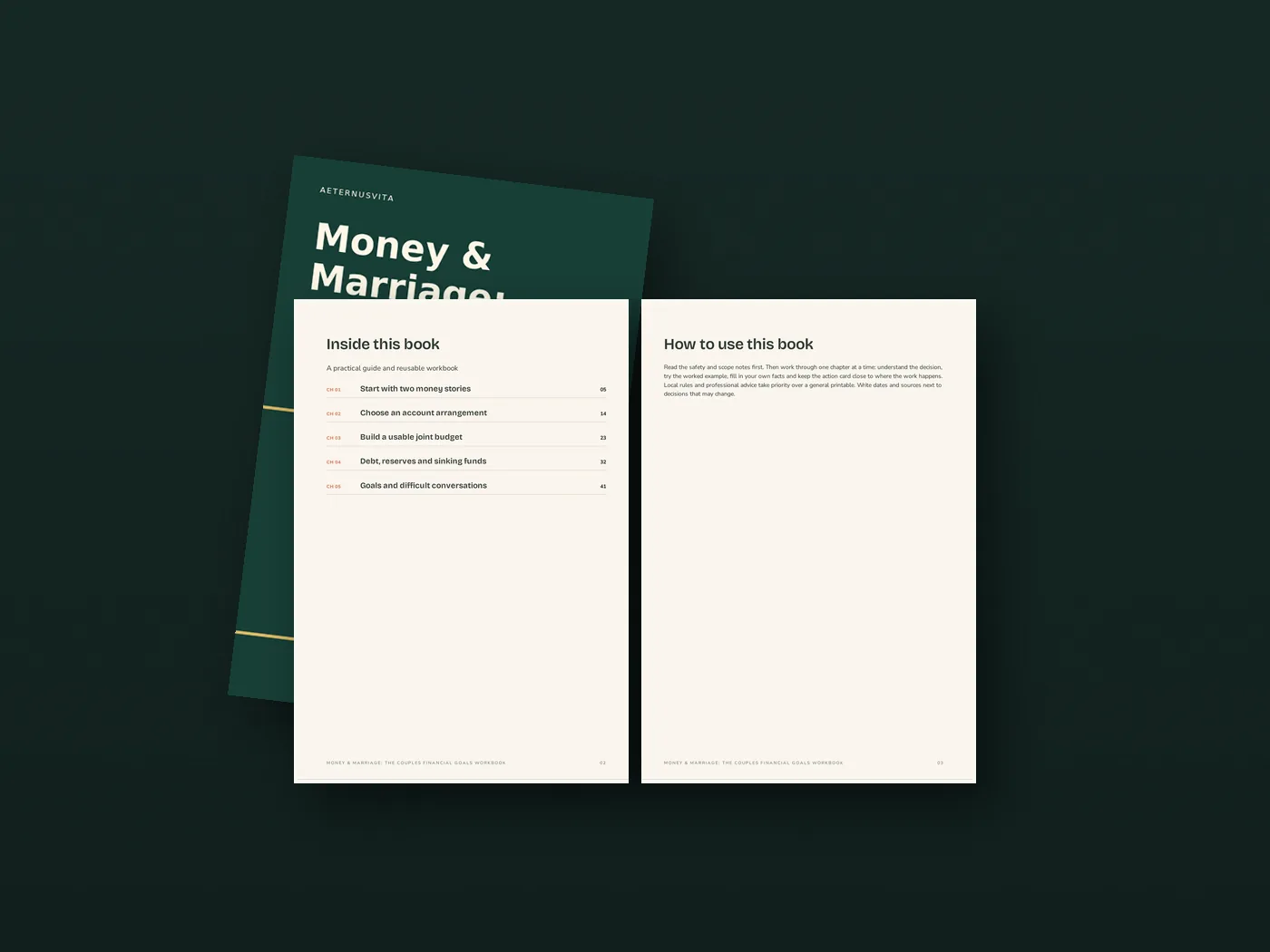
- Opening pages: how to use the book, scope notes, and a starting point for what you know and what is still open
- Chapter 1: two money stories, ten minutes apart, one shared value, unresolved items parked
- Chapter 2: joint, separate or hybrid accounts, a contribution rule and a three-month review
- Chapter 3: zero-based budget grid from take-home income, plus a 50/30/20 comparison table
- Chapter 4: debt table, snowball or interest-first, a twelve-category sinking-fund planner and a net-worth snapshot
- Chapter 5: one-year, five-year and ten-year goal pages, a money date and five conversation scripts
Preview the pages
Still have questions?
Is this financial advice?+
No. It is educational, and it is not licensed financial, legal or relationship advice. The book tells you to seek a qualified professional where a decision affects safety, health, law or money. It also states that outcomes depend on your circumstances and that no particular result is promised.
What if we cannot agree?+
Record both positions and park the item you cannot settle. The goal pages ask for one small action you can both accept now. An unconfirmed figure stays blank, with a name and a date for the person who will check it.
Our incomes are very different. Does the book assume an equal split?+
You compare both incomes, then discuss equal amounts and proportional contributions. The split has to fit the incomes you actually have. The worked example keeps agreed housing and food in a shared account and leaves personal spending separate. Legal rights, debt liability and tax treatment depend on where you live and on the account contract.
Will the debt table tell us a payoff date?+
No. You list each balance, rate, minimum, due date and any extra payment. Minimums come first. You then choose a snowball, ordered by balance, or an interest-first order. The book states that a tracker promises no payoff date. Missed payments, high interest or collection letters are marked as a reason to get qualified debt advice.
What if a money talk feels unsafe?+
Pause if either of you feels unsafe. The book sends financial secrecy, coercion or fear to qualified support. The hidden-spending script asks for the full picture, time to process, a time to talk again, and a decision about outside support. Those lines are conversation starters. For therapy or a legal question, the chapter points you to a qualified person. It also says repair takes honesty and time.
How do I receive it?+
After payment you download a ZIP with the 60-page PDF and a README. The guide and the worksheets are in that single PDF. Print the chapter you are using and keep its action card with the task.
Instant PDF download · 60 pages · Printable workbook
Educational only. This book is not licensed financial, legal or relationship advice. Written with AI assistance, reviewed by AeternusVita.
Money & Marriage: The Couples Financial Goals Workbook