 1 / 5
- 30 daily pages
- About 15 minutes
- 50 anchor verses
- Safety page first
Faith and reflection · Not a treatment
Write one true line beside the frightened thought
Thirty daily pages set a scripture line next to the thought on paper. You write for about fifteen minutes and then stop. The page still counts if the feeling did not move.
- 30 daily pages, each with its own anchor, prompt, prayer, and practice
- An inventory for body, mind, and spirit, taken once before Day 1
- 50 anchor verses, each with a plain reading and a written limit
- Five breath-prayer cards and an emergency page with crisis numbers
Faith Over Fear: The Anxiety Workbook
£11
- +One 77-page PDF, guide and workbook in a single file
- +A ZIP with that PDF and a README
One-off payment. Download straight after checkout.
30-day refund. If it isn't useful, reply to your receipt within 30 days for a full refund.
Instant PDF Print or tablet Any device
What it is+
A faith-and-reflection workbook for an adult's everyday worry. Each daily page sets a short scripture reading next to a plain thought record. The safety page, at the front, tells you when to leave the exercise and contact a person or a crisis line.
What's inside+
A safety page with crisis contacts, then seven chapters. The early worksheets cover the inventory and the three-column thought records, then 30 different daily pages. Later chapters hold 50 anchor verses with a limit on each, five breath-prayer cards, an emergency card, and a five-step night close. The file ends with a seven-row trigger log, two letters, and a gratitude page.
How to use it+
Read the safety page before any prompt. If no flag applies, take the inventory, then one daily page on the days you can read. Plan on about fifteen minutes, then stop. Rehearse a breath card on a calmer day. If you miss a day, start at today's page.
Delivery and refunds+
Instant download after payment. One ZIP holds a single 77-page PDF and a README. The guide and the workbook are that one file. Refunds follow the policy shown at checkout.
Made for the hour you can pray and still be frightened

The sentence is already going
Day 1 asks where the feeling sits in your body, and what story that sensation seems to be finishing. The anchor is a plain reading of Psalm 103:14, that God knows your frame and you may ask for care. On this page a sensation stays a sensation. You do the short practice, and then you stop.

Pray more was where the advice stopped
The opening chapter names the split. Some Christian books end at pray more. Some thought-work leaves faith outside the room. Your page holds a scripture line and three columns: the anxious thought, the harsher story under it, and a smaller line you can say aloud.

You need the card before the spike
A breath card you have never tried is a poor companion in a spike. Five cards are in the book, four counts in and four counts out. You rehearse one for five slow rounds while you are calm, and you stop if you feel dizzy. On Day 16 you write a spike plan, and the real place the emergency card will live.
The problem
The loop counts your body as proof
The loop starts with a message, a sensation, a silence, or the clock. Your mind finishes it at the worst ending. The body answers in the chest, the jaw, the stomach, or the hands, and that feeling gets counted as proof. You pray, and the sentence is still running. A verse can feel too large to say in the room. The book names this loop and writes down what a page must not promise.


How it works
One page, fifteen minutes, then stop
On a day you can read, you take today's page once: one anchor, the prompts, a prayer you can mean, and the practice. Then you stop, even if you want to keep improving it. While you are still relatively calm, you rehearse one breath card for five slow rounds. The count is four in and four out. You stop if you feel dizzy. In the evening you add one row to the trigger log, or you write the word quiet if nothing spiked. If you can barely take in a sentence, the emergency card replaces a new thought record.
This workbook vs generic advice
Small enough to say out loud in this room
Anxious thinking runs a loop. A trigger arrives, the mind adds a catastrophic reading, and the body answers. That answer then gets treated as proof. The thought record interrupts the loop at the reading. Column A is the sentence in your mind's own words. Column B is the harsher story under it. Column C is one checkable fact, or one plain reading of a verse, small enough to say without feeling lied to. If the fear is partly right, Column C leaves room for the part that is real.
Scripture, in this book, is a sentence from outside your mood. Each of the 50 anchors is a plain reading for reflection, with a limit beside it. Several lines refuse a timetable. A weak body is not given a leaving date. A bare month is not told the account will refill. You still open the bill, and a health question still goes to a GP. If a verse has been used to shame you for still being anxious, you set that verse down. When you want the passage itself, you open the translation you already trust.
You practise the breath on a quiet day, so the card is familiar before a spike. When reading is hard, the emergency page outranks the worksheet. A missed day does not create a quota. You start at today's page.

Thirty daily pages01
Four weeks, then two days to look back
Week one names the prediction. Week two tests it with facts for it and facts against it. Day 10 is a health fear with a stop rule. Safety symptoms mean you call emergency services. That page cannot clear a symptom. A money fear asks for the actual figure. Week three takes one setting a day. Those settings include the hour before the phone, a spike plan written while calm, and the worry that waits for the dark. Week four stays with one situation at a time. Days 29 and 30 look back. Day 30 tells you what you must not conclude from a month of paper.

Fifty anchor verses02
Each line tells you where it stops
You choose the line while you are calm, and you pick one for the week. Each of the 50 is a plain reading for reflection, with a limit written beside it. Safety, income, healing, and a quiet night sit outside what that line is allowed to promise. If a verse has been used to shame you, the book tells you to set it down. The reading in the workbook is not a translation. When you want the verse itself, you open the Bible you already trust.
Breath, night, and a spike03
Rehearse the breath while you are calm
Five breath-prayer cards use four counts in and four counts out. You rehearse five slow rounds while you are calm, and you stop if you feel dizzy. At the peak of a spike, the book sends you to the emergency card. A thought record is a poor tool when you cannot read a paragraph. Day 16 has you write four moves in your own words while you are calm. They are a safety-flag check, five things you can see, a longer out-breath if it is comfortable, and one small true sentence. A five-step night close is there for the worry that shows up after the lights are low. The seven-row trigger log records what spiked. You do not score the week from it.

As easy as it gets
Three moves, on a day you can read.
1Step 1
Check, then take stock
Read the safety page. If no flag is true today, fill in the inventory for the last seven days across body, mind, and spirit. The scales record the last seven days. Distance from peace is written there. The book does not turn that distance into a grade.
 2
Step 2
Do one day's page
Open today's worksheet only, and give it about fifteen minutes. It holds one anchor, the prompts, a prayer you can mean, and the practice. A finished day is the lines you could write, or an honest note if the practice would not come.
 3
Step 3
One row, then close it
If something spiked, add one row to the seven-day trigger log. If the day was quiet, write the word quiet and the rough shape of the day. Leave the paper where you will not reopen the replay tonight.
Timeline
What to expect
Hours differ. Here is how the book is designed to be used.
Read the safety page
You check the get-help flags before any prompt. If none apply, you fill the body, mind, and spirit inventory for the last seven days. You also write what you will not ask these pages to do. One daily page is there if you can read.
What's inside
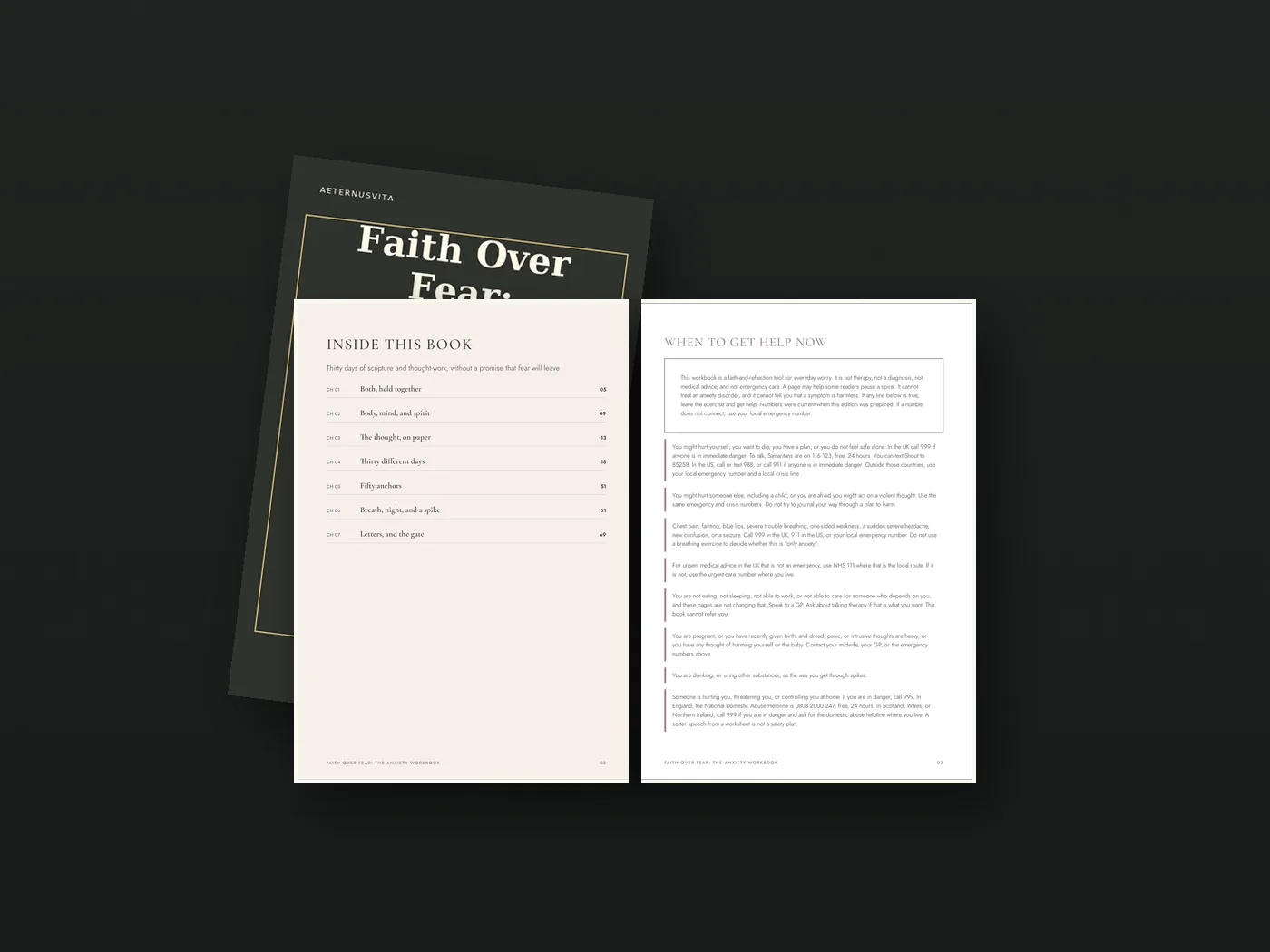
- Safety page: get-help flags, crisis contacts, and lines for your GP, a counsellor, and a person who can come
- Chapter 1: the anxious loop, what a page must not claim, the fifteen-minute shape of a day, and a missed day
- Chapter 2: a body, mind, and spirit inventory for the last seven days, scales included, with no diagnosis attached
- Chapter 3: columns A, B, and C, a ten-minute order for shaky hands, and one filled record marked as invented
- Chapter 4: 30 daily worksheets, each with its own anchor, prompt, prayer, and practice
- Chapter 5: 50 anchor verses, each with a plain reading, a use, and a limit
- Chapter 6: five breath cards (four in, four out), the emergency card, a five-step night close, and a seven-row trigger log
- Chapter 7: a gate for the month, letters to the fear and to God, and a gratitude page that keeps the hard line
Preview the pages
Still have questions?
What if I miss a day?+
Start at today's page. Missed days are not a debt. The book tells you not to begin again at Day 1 unless you want to. If you miss a week, the inventory and the safety page still stand.
Is this a treatment for anxiety?+
No. It is a faith-and-reflection workbook for everyday worry. It cannot treat an anxiety disorder, diagnose you, or tell you a symptom is harmless. The book says a page may help you interrupt one loop, and that it may do nothing visible. Nothing in it promises less anxiety, better sleep, a calmer faith, or a spike that passes in a set number of minutes.
What is on the emergency page?+
Get-help flags, including danger to yourself or someone else, emergency symptoms, danger at home, and readers under 18. Contacts named in this edition: in the UK, 999 if anyone is in immediate danger, Samaritans on 116 123, and text Shout to 85258. NHS 111 is listed for urgent advice that is not an emergency. In the US, call or text 988, or call 911 if anyone is in immediate danger. The book says the numbers were current when the edition was prepared. If a number does not connect, use your local emergency number.
Who is it written for?+
An adult. The safety page says anyone under 18 should use it only with a parent, carer, or clinician. If a child or teenager is the one in distress, the book says to speak to a GP. This workbook is not a stand-in for that care. On days you can barely read a sentence, you use the emergency card. Save the thought record for a day you can read a paragraph.
How do I get it, and do I need a printer?+
After payment you get an instant download: one ZIP with a single 77-page PDF and a README. The guide and the workbook are in that one file. The book asks you to write by hand if you can, so you can print the pages or write the lines on your own paper. One honest line is a finished practice. Refunds follow the policy shown at checkout.
Instant PDF download · 77 pages · One combined file
Educational only. This workbook is a faith-and-reflection tool for everyday worry. It is not therapy, not a diagnosis, not medical advice, and not emergency care. Written with AI assistance, reviewed by AeternusVita.
Faith Over Fear: The Anxiety Workbook