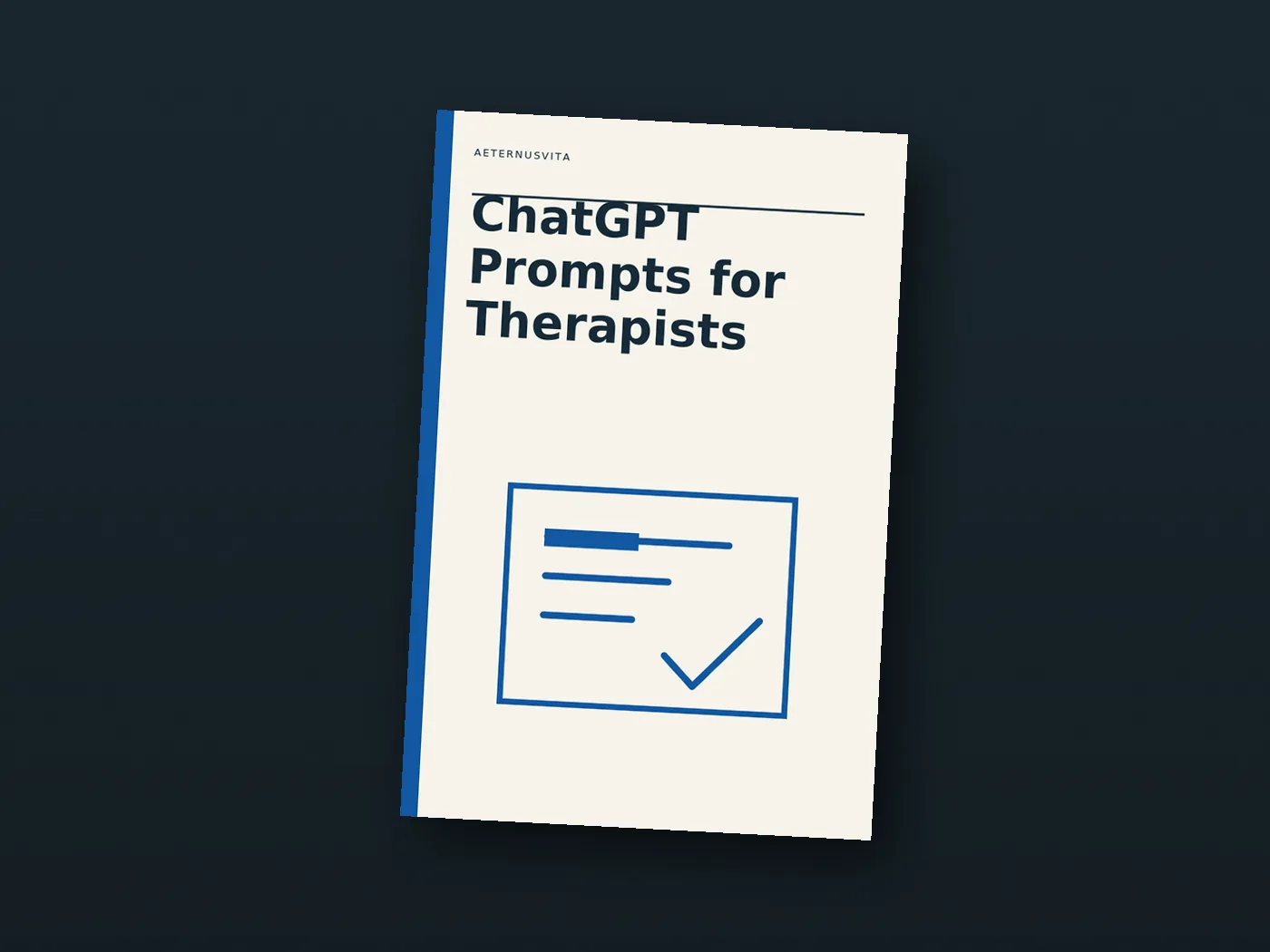
 1 / 5
- 100 numbered prompts
- De-identify first
- Six-move review
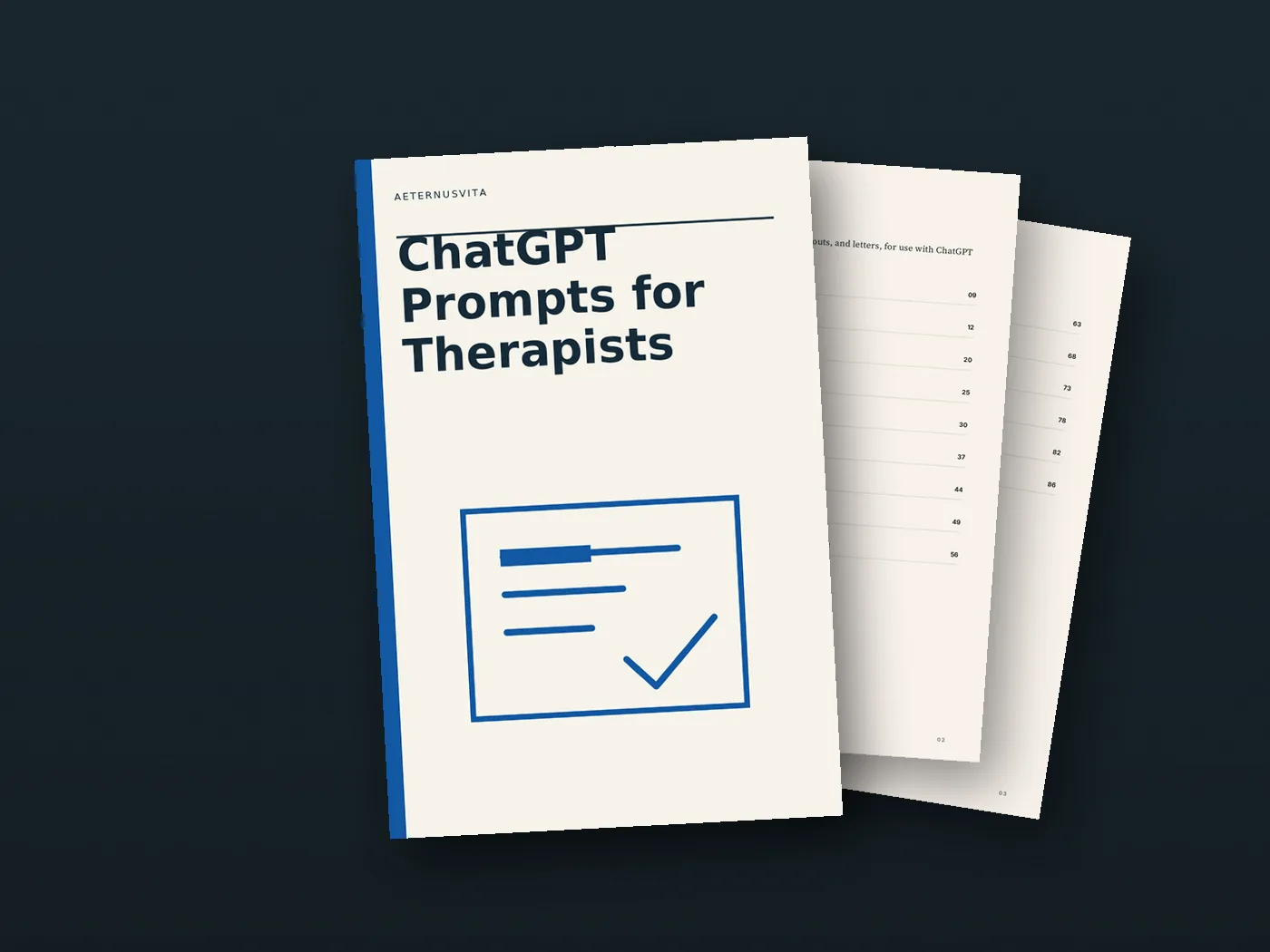
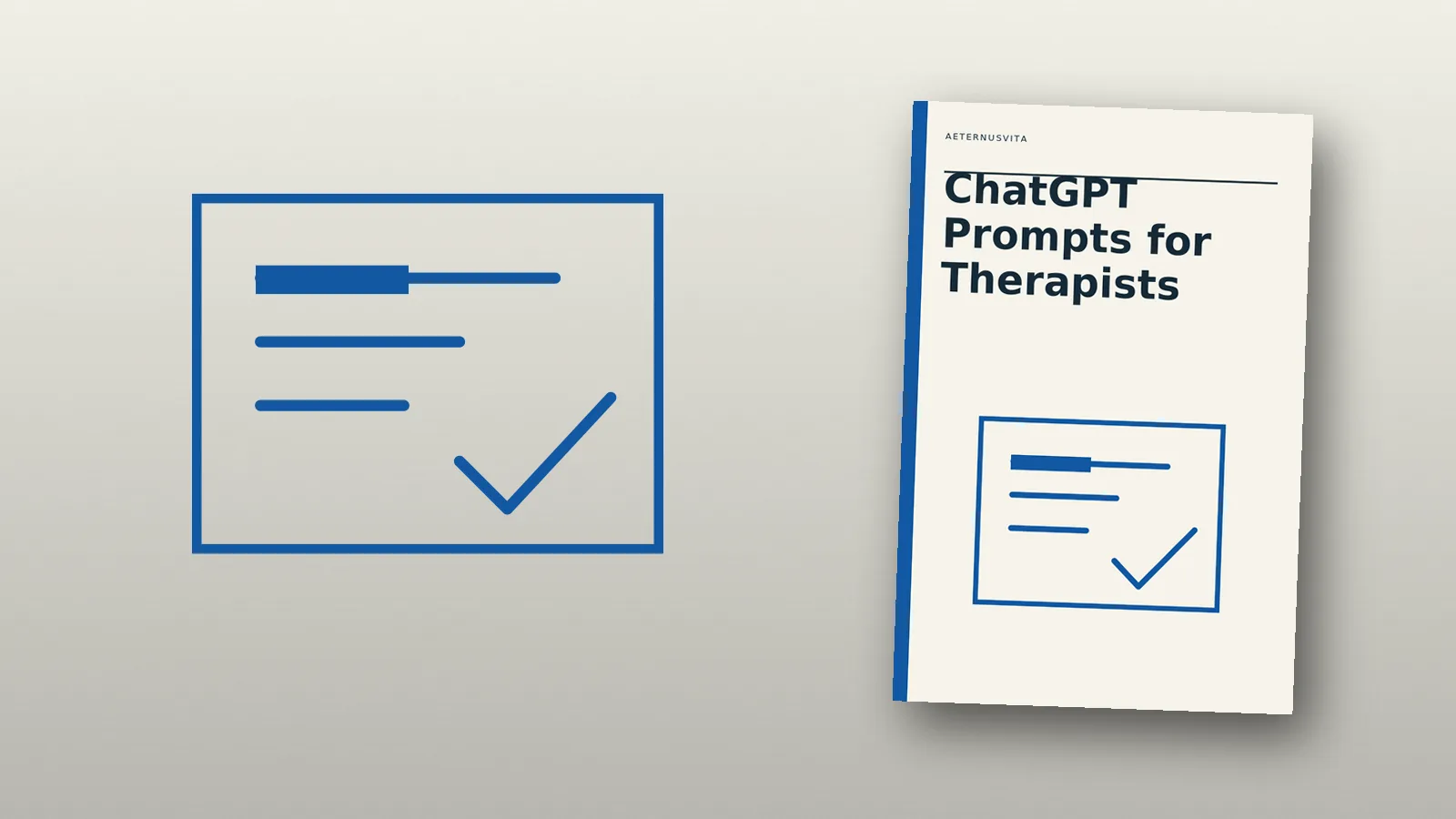
- 91 pages in the PDF
Clinical paperwork · Prompt library
100 prompts. You still sign the note.
100 numbered prompts for plans, notes, handouts and letters. Each one asks for de-identified input and marks the reply as a draft you still sign.
- Prompts 1 to 30: treatment-plan skeletons, plus SOAP, DAP and BIRP notes
- Prompts 31 to 100: differential questions, handouts, homework, discharge, letters, supervision and groups
- A five-minute de-identification pass, with eighteen identifier types on one desk list
- Standing instructions C1 to C10, and a log for timing your own paperwork
AI Prompts for Therapists
£19
- +One combined book PDF (guide and workbook in a single file)
- +Instant download: PDF files you can print or use on a tablet
One-off payment. Download straight after checkout.
30-day refund. If it isn't useful, reply to your receipt within 30 days for a full refund.
Instant PDF Print or tablet Any device
What it is+
A prompt library and short workbook for qualified therapists, counsellors, psychologists, and trainees who use prompts only inside supervision. The prompts draft shape and wording for ChatGPT and similar tools. You decide what is true, what goes in the record, and what is signed.
What's inside+
The front of the book is an ethics primer, a five-minute de-identification pass, and a six-move review. One hundred prompts follow, numbered from treatment plans through group outlines. C1 to C10 are extra standing instructions. Chapter 15 is a log for your own hours.
How to use it+
Fill a baseline week before you change method. For each prompt: de-identify, paste the prompt, then your bullets, and read the draft with the six moves. Write the finished document in your own record system.
Delivery and refunds+
Instant PDF download after payment: the guide and the companion workbook, in a ZIP with a README and a licence. This edition is the whole product. Refunds follow the policy shown at checkout.
Made for the paperwork you still have to sign
Notes still open after clinic
Progress notes stall when a full hour has to fit SOAP, DAP or BIRP. Prompts 16 to 30 draft that shape from de-identified bullets. You write the risk line after the draft exists.
A letter will leave the building
Discharge, transfer, appeals and referrals are prompts 63 to 78. Someone outside the room will read them. Prompt 75 is written so the draft refuses to masquerade as a fit note. You keep only the authority you already hold.
Prompts only inside supervision
Trainees are included when the prompts stay inside supervision. Prompts 79 to 86 structure a conversation with your actual supervisor. If the code you practise under is tighter than the book, the code wins.
The problem
The blank page at the end of clinic
The pile looks like one job called notes. Progress notes stall when a full hour has to fit SOAP, DAP, BIRP, or the letters your service uses. Treatment plans stall on an empty goal line. That line is tempting to fill with jargon. Letters stall when someone outside the room will read them. One inflated adjective can become a claim you did not mean.
How it works
The prompt goes in before the bullets
De-identify with the five-minute pass in chapter 2. Paste the numbered prompt first, then your bullets. Fill every square bracket, or leave the label where the words are still yours. Read the draft with the six moves in chapter 3. Write the finished document in your own record system. The prompt supplies the headings and the bans. You decide what is true enough to sign.
This book vs generic advice
The prompt brings the headings and the bans
A vague prompt spends the evening twice. You wait for fluent prose, then you delete what that prose invented. A prompt in this book names the document and writes the bans before you add a single bullet.
Each prompt was written to pass the checklist in chapter 2. The prompt asks for de-identified input, tells the tool to invent nothing, and calls the output a draft. For these prompts, reviewed means passing that checklist.
Chapter 15 starts with a baseline week, filled in the way you write now. The same chapter has a four-week documentation-time log and a prompt-quality log. You enter the figures yourself.
Before you paste01
Five minutes, eighteen identifier types
Chapter 2 is a five-minute pass on paper or in a local file. You mark identifiers, swap people for roles, and soften time and place. You read the brief aloud. Then the prompt goes in, and the bullets follow. A desk table lists the eighteen US safe-harbor identifier types in plain language. The book calls that table a working copy. Stripping a note with this chapter does not, by itself, prove the text is de-identified under US HIPAA or UK GDPR.
Before you file02
Six moves on the draft
Chapter 3 budgets about twelve minutes the first week. The moves are facts, identifiers, certainty, method, voice, and the next person who might read the file. Fluent sentences can still be wrong. A claim stays out of the record until it traces to your bullets and you are willing to sign it.
Prompts 1 to 10003
Numbered once, so you can count them
Fifteen treatment-plan skeletons and fifteen progress notes come first. The rest cover differential questions, handouts, homework, discharge, letters, supervision, public pages and groups. Custom instructions C1 to C10 sit in chapter 4, outside the hundred. Modality names are findability labels for work you already practise. None of these prompts is a licence to start that therapy.
As easy as it gets
The same order, every time you paste.
 1
Step 1
De-identify
Run the five-minute pass. If an identifier is still in the text, stop and write the document yourself.
 2
Step 2
Paste the prompt
The numbered prompt goes in first, with its bans. Your de-identified bullets follow.
3Step 3
Review, then file
Do the six moves. Write the real document in your own system. Once identifiers are back in, leave the reply out of the chat tool.
Timeline
What to expect
Caseloads and services differ. Here is how the book is designed to be used.
Read the limits first
Read how to use the book, the limits page, and the ethics primer. Use a draft only when the chapter 2 pass is done and your policy allows that tool. The six moves happen before you file or send.
What's inside
- Opening pages: how to use the book, the limits, and an ethics primer on when a draft is allowed
- A baseline week worksheet, to fill in before you change method
- Chapter 2: the five-minute de-identification pass, eighteen identifier types, and a table for paste, rewrite, or leave closed
- Chapters 3 and 4: the six-move review, the prompt formula, and standing instructions C1 to C10
- Prompts 1 to 15: three treatment-plan skeletons each for CBT, DBT-informed, EMDR-informed documentation, parts-informed, and ACT
- Prompts 16 to 30: progress notes in SOAP, DAP, and BIRP, five for each format
- Prompts 31 to 70: differential questions, psychoeducation, between-session worksheets, discharge and transfer
- Prompts 71 to 100: letters, appeals and referrals, supervision outlines, public website copy, group outlines and a facilitator note
- Chapter 15: a four-week time log, a prompt-quality log, an end-of-week filing check, and a stop-before-you-paste desk card
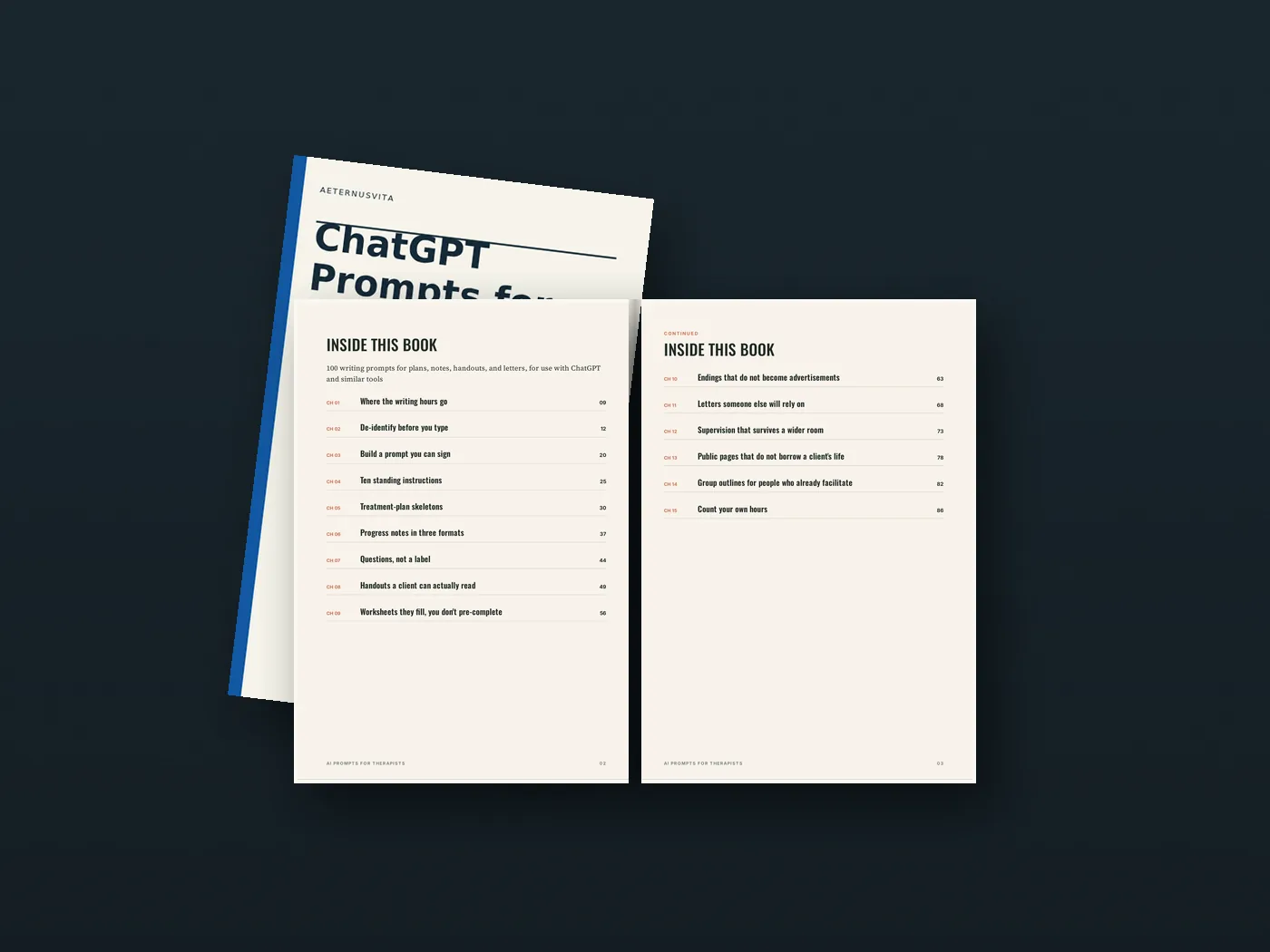
Preview the pages
Still have questions?
Can I paste a client's name or story?+
De-identify first, with the five-minute pass and the desk list of eighteen identifier types. If a name, a precise date, a narrow place, or a unique quote is still in the text, leave the tool closed. Stripping a note this way does not prove the text meets US HIPAA or UK GDPR. The book is not a business associate agreement. In the UK, health data is special-category data under UK GDPR and the Data Protection Act 2018. Follow the body that regulates you, and your organisation's policy.
What does reviewed mean?+
Each prompt was written to pass the checklist in chapter 2. It asks for de-identified input, tells the tool to invent nothing, and calls the output a draft. For these prompts, reviewed means passing that checklist. No university, insurer, or professional body has accredited these prompts.
Will this cut my documentation time?+
You count the hours. The book does not invent them, and it does not promise any fraction of them back. Chapter 15 is a baseline week you fill before changing method, plus a four-week log for a later week in which you tried a handful of prompts.
Is this training, a diagnosis, or supervision?+
No. It is an educational prompt library for paperwork you already write. CBT, DBT-informed, EMDR-informed documentation, parts-informed work and ACT are findability labels. Skip a modality you do not practise. Prompts 31 to 38 ask for questions and gaps. Any label or code stays in your own assessment. The supervision prompts only structure a conversation with your actual supervisor. Continuing-education credit is outside this book.
Does it only work in ChatGPT?+
The prompts are written for ordinary chat tools with a box you can type in. ChatGPT is one of them. A name on the cover is not permission to send that company a client note. If your employer has an approved tool inside the record system, follow the employer's instructions.
How do I get it?+
After payment you get an instant download: one combined book PDF (guide and workbook in a single file), in a ZIP with a README and a licence. This edition is the whole product. There is no quarterly prompt drop. Refunds follow the policy shown at checkout.
Instant PDF download · 91 pages · Guide and workbook
Educational only. This book is not medical or legal advice, and it is not a treatment or a privacy certification. Written with AI assistance, reviewed by AeternusVita.
AI Prompts for Therapists