 1 / 5
- Eight paced weeks
- 115 printable pages
- Boundary scripts
- Eight read-alouds
Educational workbook · Workplace strain
Name the week. Leave the new planner closed.
An eight-week workbook for a long stretch of workplace strain. If a week needs three weeks, you give it three weeks. You write this week at the size of a named meeting and a time of day, then remove one optional thing before you add a new system.
- Week 1 asks for a name you choose for this stretch, with no clinical term, and for seven mornings of noticing
- In Week 2 you remove one optional thing and write the date you will review it
- The boundary chapter includes a delay sentence and a worked reply to a Friday 8am ask
- You also get a warning-signs checklist and eight read-aloud scripts you can record
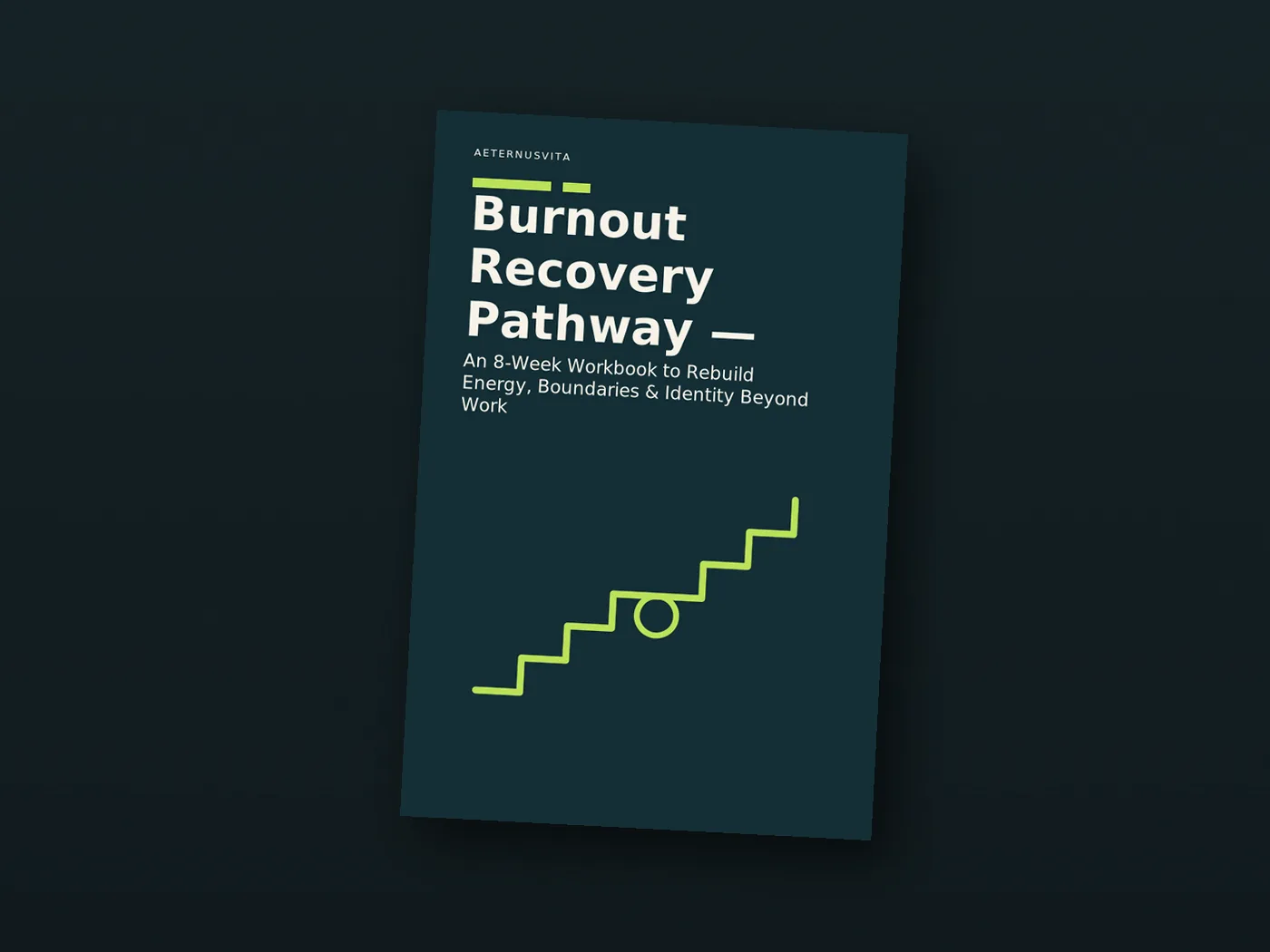
Burnout Recovery Pathway
£27
- +8-week workbook PDF, 115 pages
- +Warning-signs checklist and supplemental worksheets
- +Boundary scripts plus eight read-aloud scripts, as text
One-off payment. Download straight after checkout.
30-day refund. If it isn't useful, reply to your receipt within 30 days for a full refund.
Instant PDF Print or tablet Any device
What it is+
A workbook for adults whose work has started to feel like the whole of them. Eight weeks is the length of the pages, and a week can take longer if it needs to. If a line on the safety page is already true, the book tells you to contact a person before any worksheet.
What's inside+
Week chapters run from naming where you are through to a forward plan. The scripts section holds wording you rewrite in your own voice before you send it. Eight read-alouds are included as text, for your voice or a text-to-speech tool you already trust.
How to use it+
Read the teaching pages once and fill the sharpest worksheet while the details are still specific. On two other days, spend ten minutes on a prompt or a read-aloud. Once in the week, do the one action you named. The other days are ordinary life. If a week needs three weeks, give it three weeks.
Delivery and refunds+
Instant PDF download after payment. 115 pages. Print the worksheets, or read them on a screen. Refunds follow the policy shown at checkout.
Made for the Monday that still feels heavy

The edge is back by lunch
You slept, or you tried to. By Monday lunch a single reply feels heavy, and so does the walk from the car. Week 1 asks for the hour your energy dropped, and what you were doing.

A new planner joined the pile
You coloured in a fresh week and named an early block deep work. You slept through it. The blank block looked like a moral failure on top of the list. Week 2 tells you to leave the new system closed and remove one real thing, with a review date.

You lead with the job title
Week 6 asks you to name parts of your identity beyond a job title or caring role, then set aside fifteen minutes for an activity with no output to measure.
The problem
A weekend off was too small a test
You are still getting the work out of the door. At home you are shorter than you mean to be. A weekend off has already been tried, and the edge is back. Laziness is a poor name for a heavy inbox beside a night of broken sleep. The workbook asks you to write the week in objects and times, and to take frightening body symptoms to a GP.


How it works
Read once, write one page, then stop
A week in this book is small on purpose. On day one you read the teaching pages and fill the sharpest worksheet. Two other days get ten minutes on a prompt or a read-aloud. Once in the week you do the single action you named, such as sending a delay sentence or leaving one optional meeting. The other days are ordinary life. Stop if a practice leaves you dizzy, panicky, faint, or ashamed. Skipping is a complete use of that page.
This workbook vs generic advice
A finer planner asks a tired week to perform
The useful line is small enough to see. The first worksheet wants the meeting you dread and the time of day it arrives, because 'work' is too large to change.
Week 2 shows a 6am block you sleep through, and a blank space that then looks like failure. You take one real thing off, with a review date. Medicine, a child's basics, the rent, and a safety check your job requires stay on the must-stay list.
Some readers feel a little more room in the week. Others feel nothing. Looking can also make the week look worse, which the book treats as a reason to stop and speak to a person.
Week 101
Three features, and no score
You name whichever feature is loudest. It may be energy that does not refill after sleep, or distance from the people around you, or effort that feels as if it is missing. One is enough, and 'I don't know' is a valid choice. A four-rung ladder is only language, and the far rung closes the exercise so you can use the safety page. Seven mornings take one line each. There is no total underneath.

Week 4 · Scripts02
A limit is a sentence you then keep
A boundary here is a sentence plus a behaviour you follow. You write operating hours your rota already allows, and a delay so a new request can wait until tomorrow. The worked reply to a Friday 8am ask offers a later time or a one-page note, and it keeps your health out of the thread. Later pages hold a sick-day note and wording for home. Check a contract, a visa, or a professional registration with someone who knows those rules before you send.
Week 503
Keep the duty, and shrink a different drain
You name five drains and five restores a camera could see, including one drain you are keeping on purpose. A school run can stay. A status meeting with no agenda is a size you can question. If leaving the job is impossible this year, the page asks what 10 per cent of one drain might move, such as one evening of mail. When even that cannot move, it points you towards a GP, a union, or a friend who can take one school run.

As easy as it gets
The pace written into each week.
 1
Step 1
Read the teaching pages
Once through is enough. Unread pages keep until you come back.
2Step 2
Fill the sharpest worksheet
Write the meeting, the time, and the name while they are still specific. 'I don't know yet' is a finished line.
 3
Step 3
One action, then stop
Send a delay sentence, or leave one optional meeting. A blank day stays blank. You do not invent it the next night.
Timeline
What to expect
People move through this at different speeds. Here is how the pages are designed to be used.
Write the opening snapshot
Name the dread and the time it arrives, plus who gets the sharp version of you. You also write the number you would call in a crisis. 'I don't know yet' closes a line you cannot answer.
What's inside
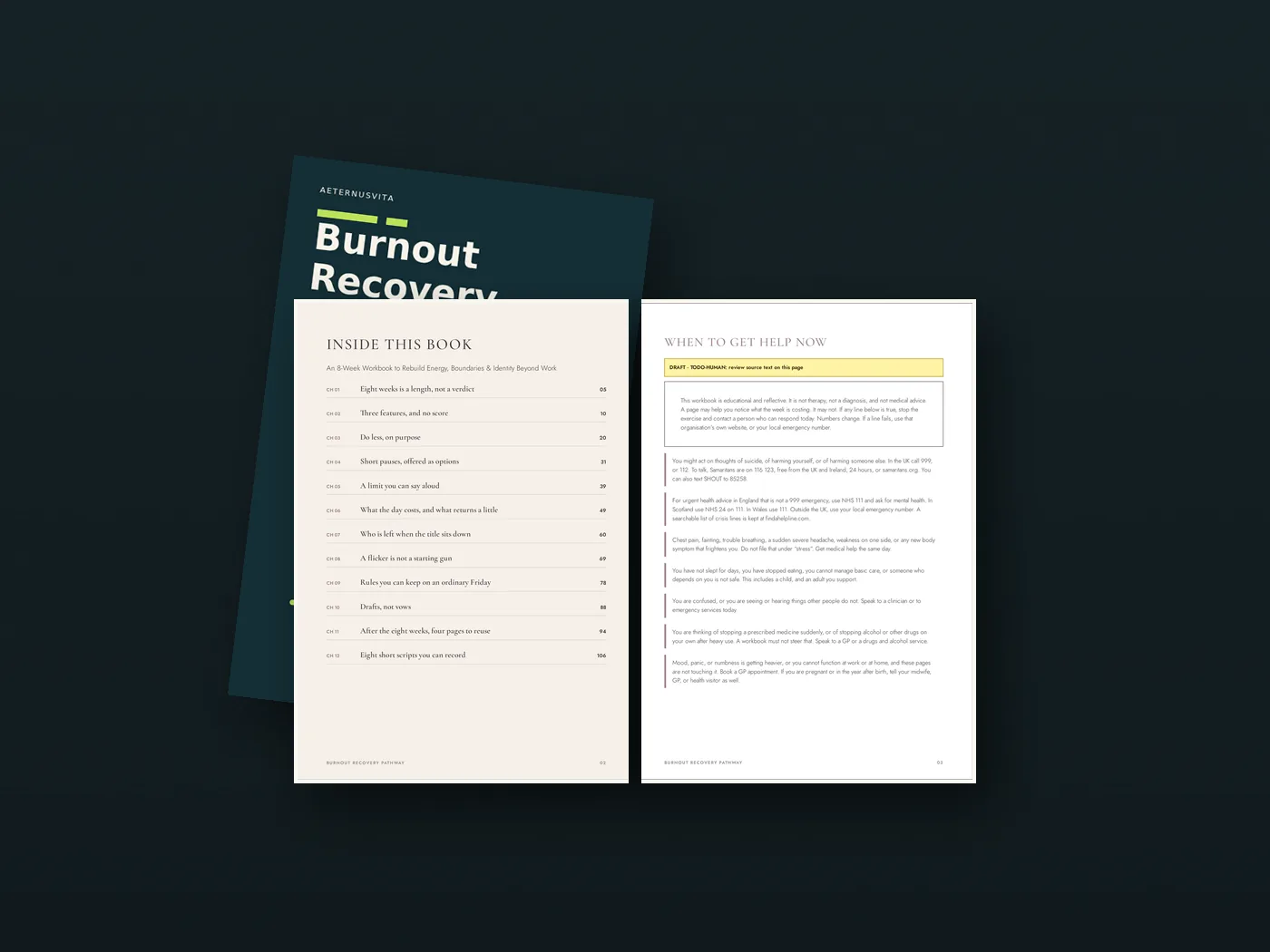
- Safety page with public crisis contacts, and a reminder to check numbers on the organisations' own sites
- How to pace a week: one read, one worksheet, ten minutes on two further days, then one action
- Week 1: three features of a long strain, a ladder you can step off, twelve lines, seven mornings
- Week 2: drops, delays, and hand-overs, a permission slip, and what you will not add
- Week 3: four optional pauses, each with a way out, a seven-night note, and a two-minute pocket card
- Week 4: operating hours, a day's delay on non-urgent requests, and one optional commitment to leave
- Week 5: five drains and five restores, then one drain to shrink while a duty stays
- Week 6: 'I am' lines that set the job title down, and three things with no output
- Week 7: one protected day at a size you can repeat, with a shutdown line
- Week 8: early signs and a first response, non-negotiables inside your control, a letter marked as imagination
- Scripts for workplace replies, a sick day, a leave conversation, and home or social plans
- Keepers: warning-signs checklist, a meeting audit, a ninety-day check-in, one capacity week, eight read-alouds
Preview the pages
Still have questions?
Is this a burnout test, or therapy?+
It is educational and reflective. Nothing on the page is added up into a score or a clinical label. People use the word burnout for a job with too much demand and too little control. They also use it for grief, depression, a body illness, or a life with no off-switch. Those can feel alike from the inside. A GP can look at sleep, mood, and the rest of your health. These pages look at the week you can describe.
What if I might be in crisis?+
A get-help-now page sits at the front of the book. It covers thoughts of suicide or of harming someone, plus chest pain, fainting, or trouble breathing. It also covers not having slept for days, stopping a medicine or alcohol suddenly, and harm or control by another person. For the UK it names 999 and Samaritans on 116 123. It names NHS 111 for urgent mental health advice in England, and it points to Scotland, Wales, and local numbers outside the UK. If a listed line is true, stop the worksheet and contact a person. Numbers change. Use the organisation's own website if a line fails.
What if I cannot finish a week in a week?+
Give that week three weeks. If you are ill, on nights, in a launch, or in a family crisis, pause and write the date you will open the book again. 'No date yet' is allowed. One honest page, used once, counts. You can use a single chapter and leave the rest.
Does it include audio meditations?+
No. The eight read-alouds are words in the PDF. You can read them quietly, record them in your own voice, or use a text-to-speech tool you already trust. Pause as long as you like between lines.
Will it tell me to leave my job?+
Resigning, staying, and medical leave sit outside the book. If money, a visa, a notice period, or the labour market means you cannot go, Week 5 asks what 10 per cent of one drain might move this month. Where the load is staffing or a contract, the pages point you to a union or an advice service. The scripts are not legal advice.
What if a pause makes me feel worse?+
Stop. Skipping is a complete use of that page. Leave breath practice if watching the breath raises anxiety. Skip a cold splash in pregnancy, or with a heart condition, Raynaud's, or cold urticaria, unless a clinician has already said that kind of practice is suitable for you. The book cannot clear you for it. Dizzy, faint, panicky, or ashamed means stop.
How do I get it?+
You get an instant PDF download after payment. The worksheets and the read-aloud scripts come as PDF, 115 pages in all. Print the pages you want to write on, or read them on a screen. Refunds follow the policy shown at checkout.
Instant PDF download · 115 pages · Print or read on screen
Educational only. This workbook is not therapy, a diagnosis, or medical advice. It will not tell you that you are burnt out. Written with AI assistance, reviewed by AeternusVita.
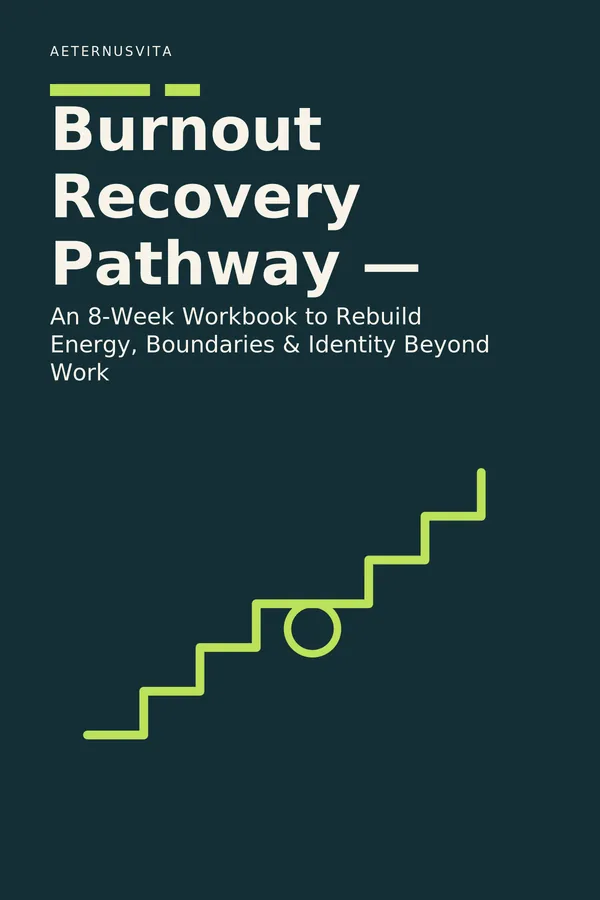
Burnout Recovery Pathway — An 8-Week Workbook to Rebuild Energy, Boundaries & Identity Beyond Work