 1 / 5
- 90 named days
- About ten minutes
- 40 grief prompts
- Guide and workbook
Empty nest journal · Guide and workbook
Ninety named days for the hours that stayed
Forty different grief prompts, about ten minutes each, for women after daily parenting thins. When a week fills up, the later dates slide.
- Forty grief prompts, each one different, with a ten-minute stop
- Roles marked ending, continuing, or still running from habit
- One outing chosen from ten, and a sentence ready if the answer is no
- A three-day trip plan with your own figures and a same-day card
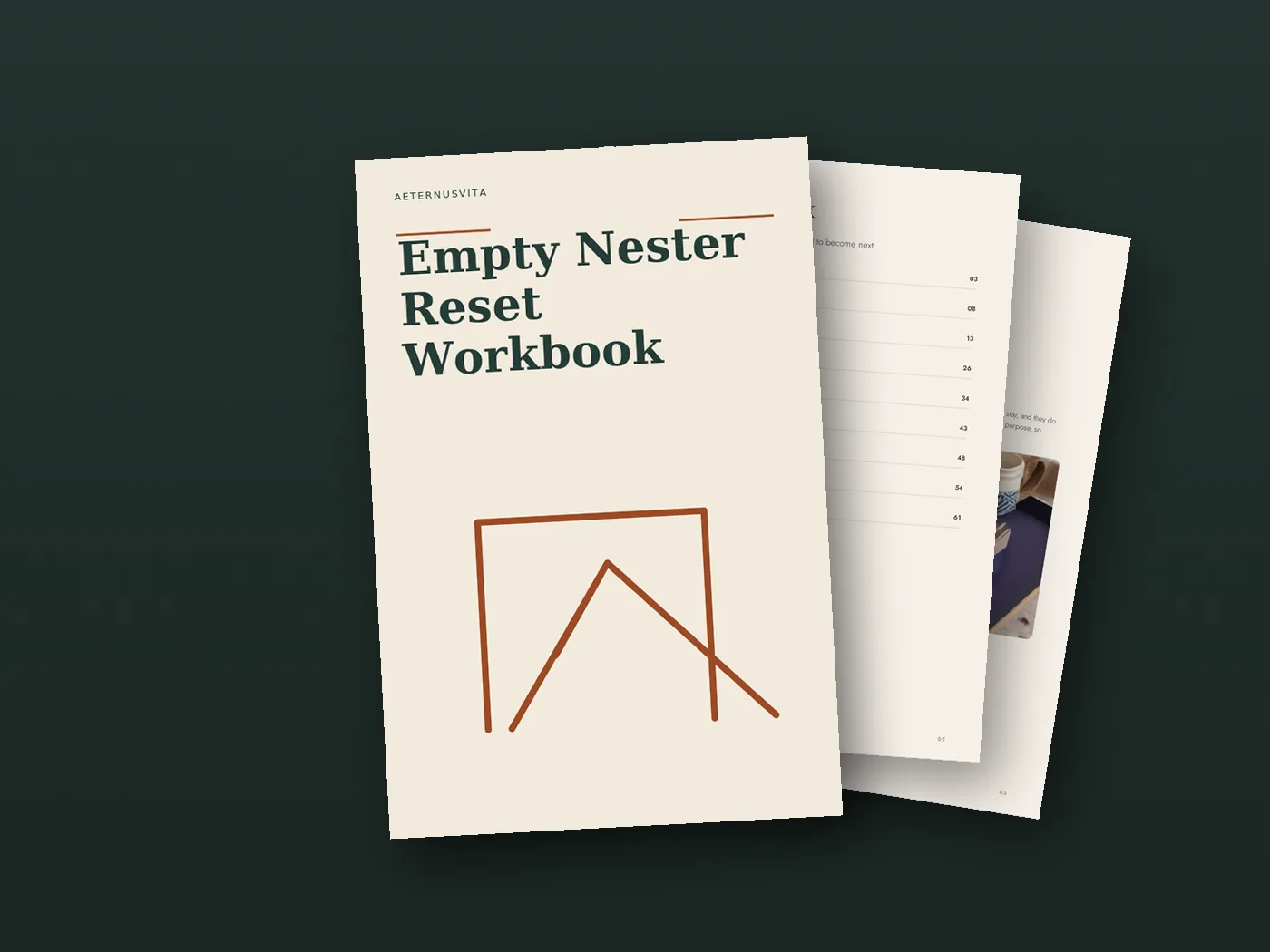
Empty Nester Reset Workbook
£15
- +One combined book PDF (guide and workbook in a single file)
- +Instant download: PDF files you can print or use on a tablet
Pay once. Download the ZIP after checkout.
30-day refund. If it isn't useful, reply to your receipt within 30 days for a full refund.
Instant PDF Print or tablet Any device
What it is+
A reflective workbook for women in the weeks after daily parenting thins. The ninety days cover a role inventory, forty grief prompts, and interests that went quiet. Later pages cover one outing, messages to at most three people, a Tuesday vision page, and a small trip plan. Chapter 1 says the workbook is not therapy or medical care.
What's inside+
Nine chapters, from a start-date page to day 90. The grief block is forty different prompts. Later chapters hold ten interest questions, ten outings, and fifteen starters. You also get a first-message script, a vision page in words then images, and a three-day trip template with the fares left blank.
How to use it+
On the morning you call day 1, read chapter 1, write your dates, and do prompt 1. Through day 40, give each prompt about ten minutes and stop. Do the longer sitting once in that block of days. From day 41, follow the named sequence. If you miss a week, continue at the next number and slide the later dates.
Delivery and refunds+
Instant download after payment: a ZIP with one combined book PDF, a README and the licence. Refunds follow the policy shown at checkout.
Made for the house after daily parenting thins

The last child has left
University, work, or a home of their own. Lifts, forms, and meals used to give the day its edges. Chapter 1 maps the ninety days after that, including the duty that will not move.

The bedroom has a new job
The room may already be a reading corner. Washing sent home, or a Thursday lift, can keep part of a role alive. A child who has come back still belongs in the inventory. Mark what ended and what continues.

A partner in the house, or none
The book is written for married, single, widowed, divorced, and unsure. With a willing partner, you offer one outing. With no partner, you pick one of three outings that work on your own, and you skip the starters.
The problem
Friends tell you to enjoy the freedom. You are still finding the light switch.
A long parenting stretch organises the week on its own. When that stretch ends, the hours stay, and they do not arrive labelled. You might miss the noise, or the version of you who was needed every hour. Relief can turn up in the same week, and guilt can follow it. The first forty days give that mix a page a day.


How it works
Ten minutes a day, then one longer sitting
Days 1 to 40 are forty different grief prompts. Each one is about ten minutes, and then you stop. Once in each block of days there is one longer sitting. Through the forty days those sittings are the role inventory, the interest questions, an outing to offer, a friendship audit, the vision in words, and a shortlist of three places. From day 41 the daily prompt is optional. The rest of the calendar is three small trials, the outing, a follow-up or a closed name, one action, and a three-day plan. Miss a day and you take the next number. The later dates slide with you.
This workbook vs generic empty-nest advice
You can see the size of today's page
Where a page is already filled in, the book says the person is invented. One sample lists practical roles, then a habit such as a full meal at six when nobody else is home. You copy that level of detail and fill it with your own week.
Each grief prompt asks for a room, an hour, an object, or a message. About ten minutes includes the time it takes to sit down. You close on a permission line. Plans wait for their own chapters.
A trial is two hours or less, once, with a spend limit you write before you look at shops. A friendship gets one message and, if ten days pass in silence, one follow-up. After that, the name can close.

Days 1 to 4001
A different prompt, then you stop
Sit where you can finish. Read only today's number, and write one concrete thing before you summarise the feeling. Add a sentence that begins "I am allowed to", then close the book. On a flat day, "nothing new today" and the time are enough. If a prompt assumes a warm goodbye, cross out the assumption and write the feeling that is in the room.

One outing02
Ten ideas, and the aim is one
Chapter 5 lists ten outings and asks you to offer one. You include how long it takes, and a line that lets either of you end it. If the answer is no, the next page gives you a short reply, and then you stop asking. With no partner, do the gallery hour, the old walk, or one album on your own, and skip the starters.

Days 84 to 9003
A trip plan you can finish on paper
Two nights nearby count. You shortlist three places and a same-day alternative, and you write your own prices on the budget lines. The three-day template keeps a half-day empty. A small card is the afternoon version you can take with you. You travel only if those dates already fit the week.
As easy as it gets
A date, ten minutes, and room to miss a week.
 1
Step 1
Write day 1
Write the date you are calling day 1, the date 89 days later, and any duty that may slide a later block. Read chapter 1 that morning, then do prompt 1.
2Step 2
Keep the ten minutes
One grief prompt. Stop when the time ends, even mid-sentence. The book treats an honest fragment as a completed day.
3Step 3
Slide the later dates
Miss a day and the next prompt waits for the next day you have. Move every later block by the same number of days. Chapter 3's note to speak to a person stays on its page.
Timeline
What to expect
Houses differ. Here is the order the pages are built to be used in.
Read the map, then prompt 1
Chapter 1 is short so the first prompt can share the morning. You write day 1, day 90, and the duty that may slide a later block. The role inventory is the longer sitting for days 1 to 7, and it can wait.
What's inside
- Chapter 1: the shape of the ninety days, your start date, and the cases that need a person
- Chapter 2: the role inventory, sorted into ending, continuing, and habit
- Chapter 3: the ten-minute sitting, then forty different grief prompts
- Chapter 4: ten interest questions and three trials of two hours or less
- Chapter 5: ten outings, fifteen conversation starters, and what to do when the answer is no
- Chapter 6: a friendship audit, one first message to adapt, and a ten-day follow-up
- Chapter 7: vision words sized for an ordinary Tuesday, then one action
- Chapter 8: a shortlist, budget lines you fill, a three-day template, and a same-day card
- Chapter 9: on day 90, reread the notebook and leave with one repeatable morning
Preview the pages
Still have questions?
What if I miss a day, or a whole week?+
Write the next prompt on the next day you have. A missed week moves every later date by the same number of days, and you record the new dates on the start-date page. Chapter 3's instruction to speak to a person stays on its page.
Is this therapy?+
No. It is a reflective workbook you write in. Chapter 1 says it will not rebuild a life by day 90, make a child phone more often, or repair a partnership that is frightening, cruel, or already over. Those situations need a person, and the book says so.
Does it cover perimenopause, sleep, or mood?+
No. The workbook does not cover perimenopause or any other medical care. For cycle changes, sleep, mood, or bleeding that worry you, chapter 1 tells you to talk to a clinician. The prompts are not a record to hand over as a diagnosis.
What if I have no partner, or a child is still at home?+
Use the pages that fit the house you have, and cross out the rest. With no partner, skip the starters and take one outing alone. If a child has returned, or is only partly gone, inventory the roles that changed anyway.
What if I feel unsafe?+
Stop the prompt and speak to a person if you are thinking of harming yourself, or if you are afraid of someone at home. Do the same if you cannot get through an ordinary day, or if hopelessness has been the colour of several weeks. The book points to a GP, a therapist, a friend who can stay on the line, or local emergency services. Another journal line is the wrong size of help.
How do I receive it?+
After payment you get an instant ZIP: one combined book PDF, a README and the licence. The pages are A4 worksheets for printing and writing on.
Instant PDF download · 64 pages · Guide and workbook
Educational only. This workbook is not therapy, medical advice, or mental-health treatment, and it does not cover perimenopause or other medical care. Written with AI assistance, reviewed by AeternusVita.
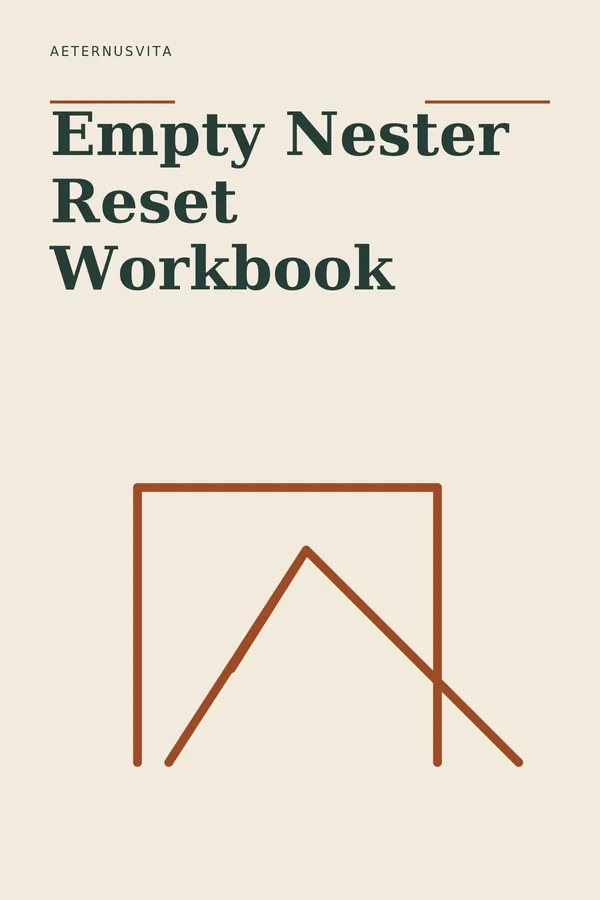
Empty Nester Reset Workbook