 1 / 5
- 90 specific prompts
- Start on any date
- Safety page first
- 59 printable pages
Body-neutral journal · Six phases
Ninety questions for this body
Six phases of fifteen specific questions, from grief through future-self. On a hard day, the date plus one true sentence completes the entry.
- Ninety specific questions, fifteen to a phase, from grief through future-self
- Missed days stay blank, and you can open whichever phase is loud
- A five-move guide for unwanted comments, plus an optional one-minute mirror page
- A pelvic referral card and appointment notes for a GP, midwife or physiotherapist
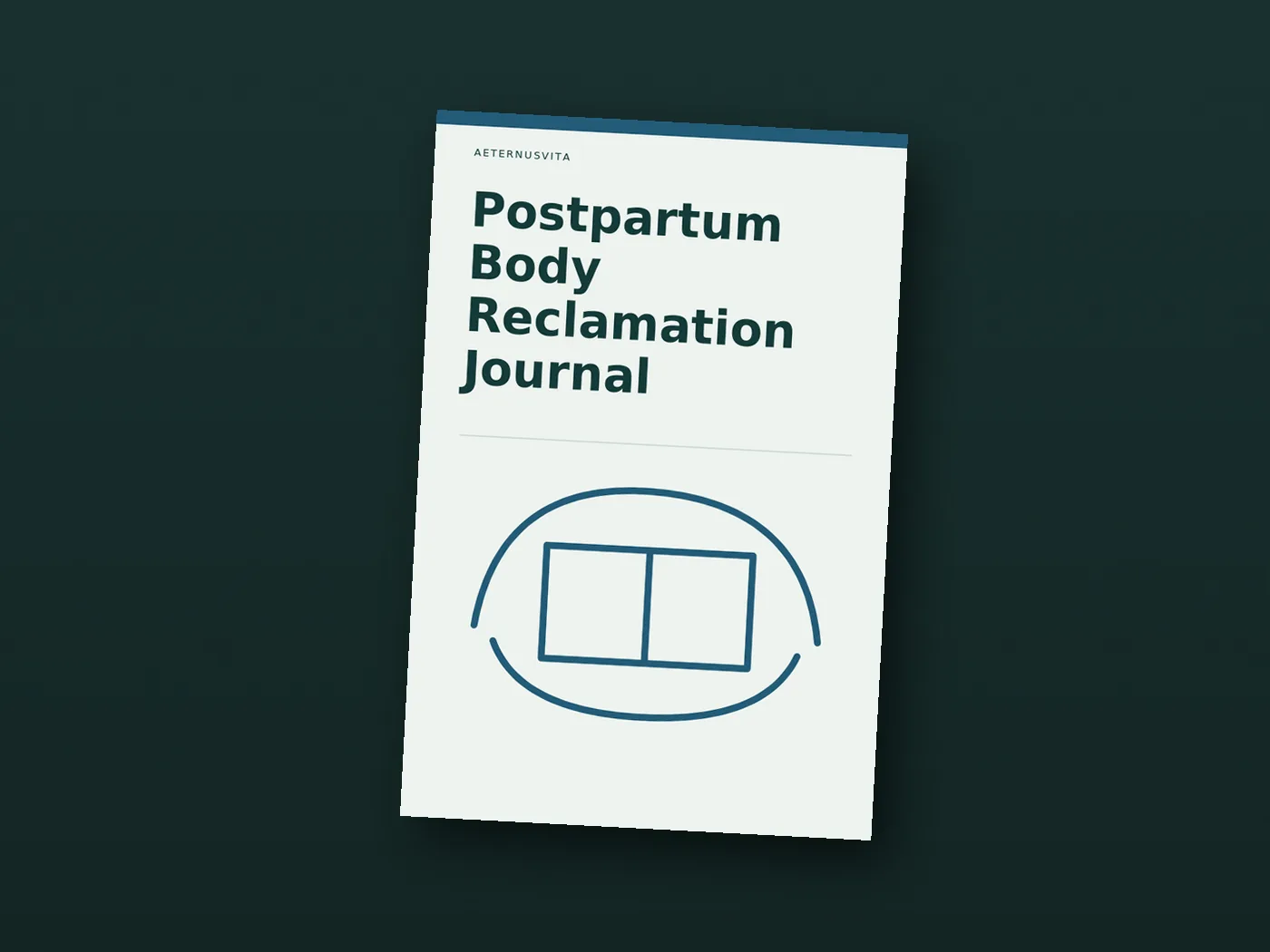
Postpartum Body Reclamation Journal
£15
- +One combined book PDF (guide and workbook in a single file)
- +Instant download: PDF files you can print or use on a tablet
One-off payment. Download straight after checkout.
30-day refund. If it isn't useful, reply to your receipt within 30 days for a full refund.
Instant PDF Print or tablet Any device
What it is+
A 90-day journal with a body-neutral stance. Ninety specific questions sit in six phases, and a safety page comes before the first prompt. You describe what is true and name ordinary care, such as a looser waistband, a glass of water or a call. Clinicians still handle bleeding, mood, pelvic symptoms and anything that worries you.
What's inside+
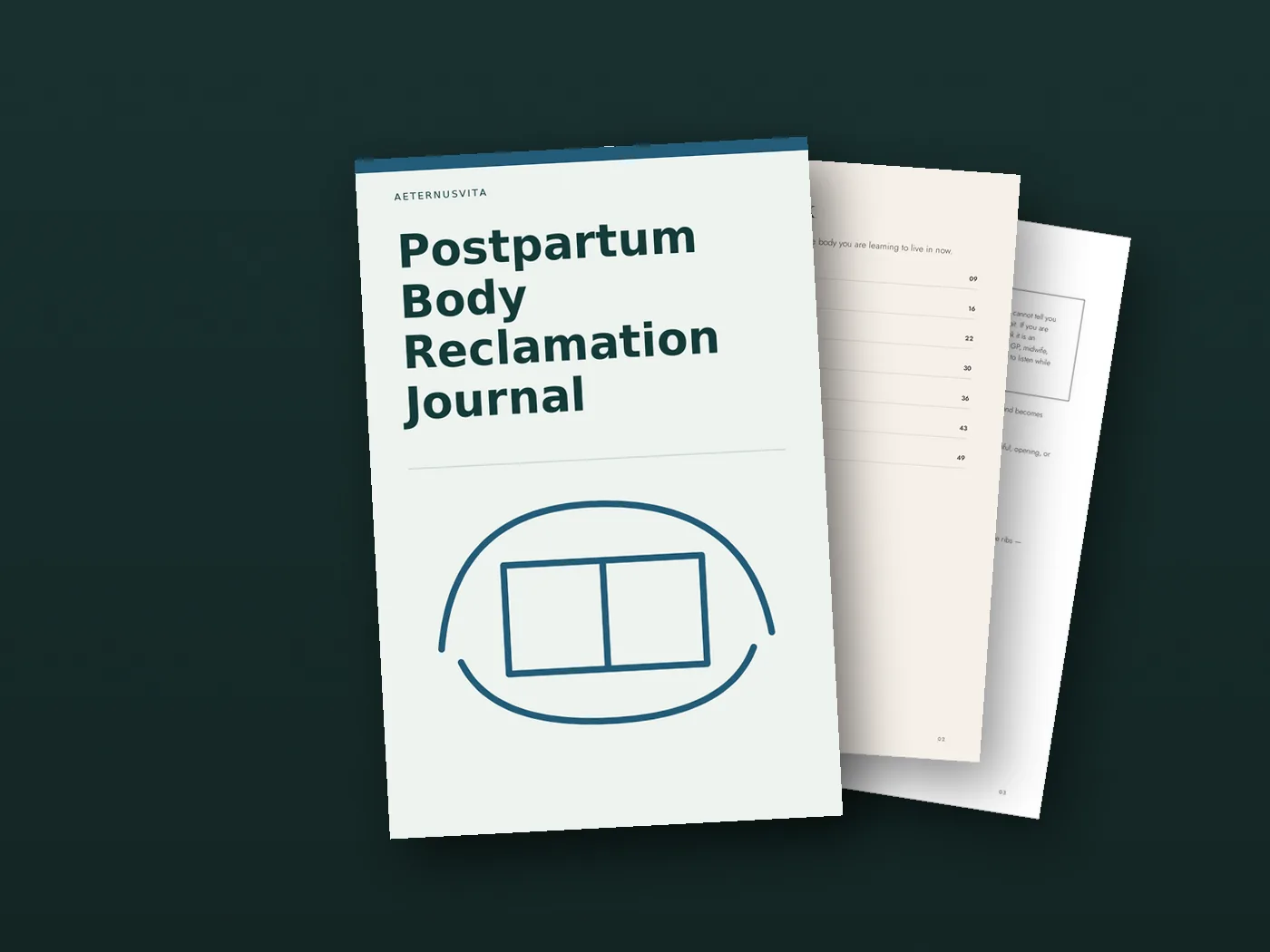
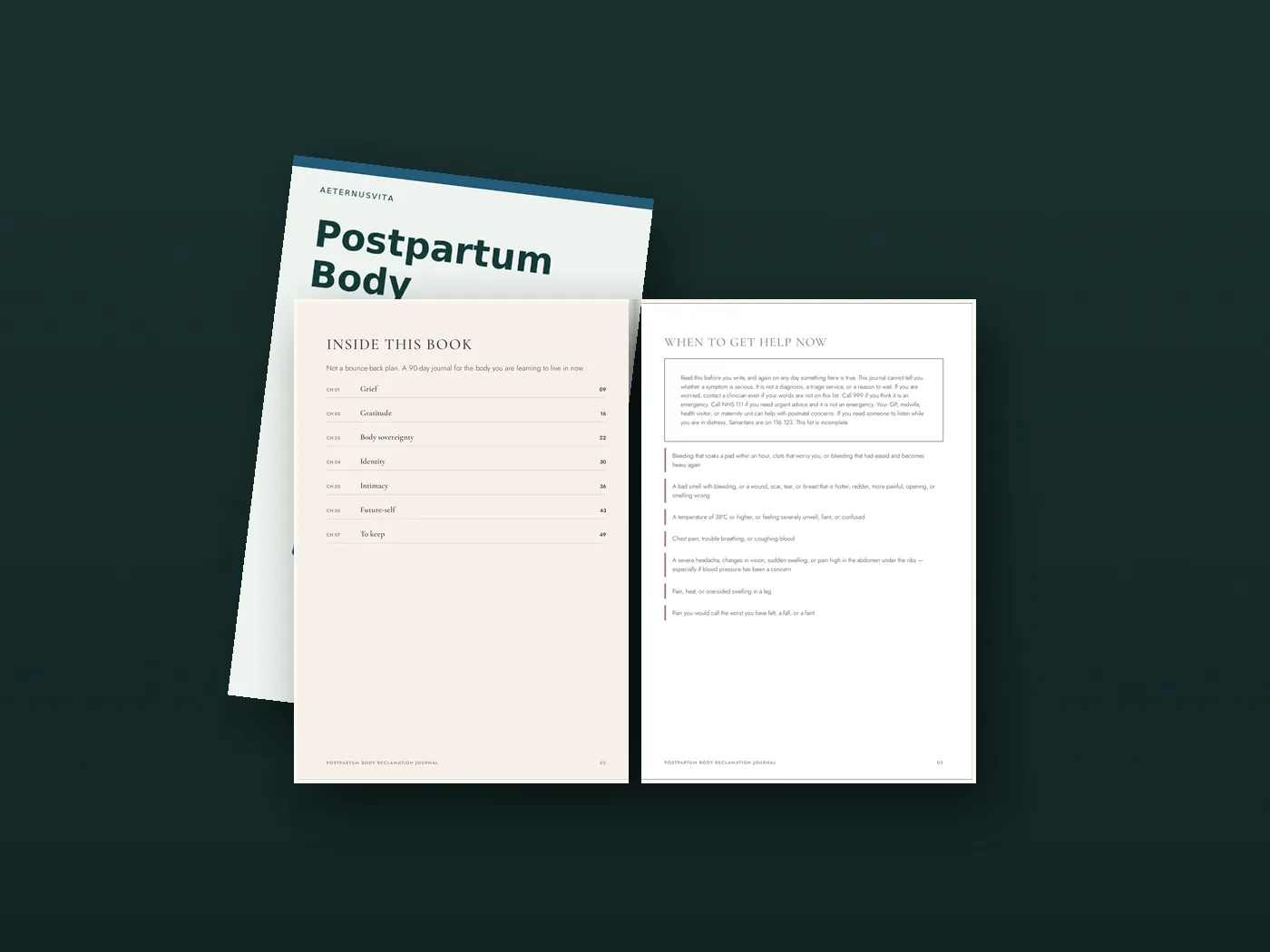
How the ninety days work, the neutrality stance, and a checklist of what stays with a clinician. Six phases follow: grief, gratitude, body sovereignty, identity, intimacy and future-self. Eighteen worksheets hold the prompts, five to a page. At the back there is a week page to reprint, a six-row phase overview and a 5-4-3-2-1 grounding sequence. A pelvic referral card and appointment notes are for a real visit. Two letters have one-line prompts, and the day-90 reread can be skipped.
How to use it+
Read the safety page. Write the calendar date beside the day number and answer that day's question. On a hard day, stop after one true sentence. A missed day stays blank. You can open the phase that matches what is loud, in any order. The birth can have been last month or three years ago.
Delivery and refunds+
Instant download after payment. The ZIP holds one combined book PDF, a README and the licence. 59 pages. Refunds follow the policy shown at checkout.
Made for a true sentence, on a date you choose

The early weeks, or years later
The early weeks are sometimes called a fourth trimester, and these ninety questions can start then. They still fit if the birth was last month or three years ago. Write the calendar date beside the day number.

Grief is being heard as ingratitude
Days 1 to 15 give you lines for the birth, the feeding, a job, a silence or a garment. Love for a baby can sit in the same hour. A true sentence about loss is not a verdict on your parenting.

You want closeness on your terms
You may want talk, quiet, a friend or nothing this week. Absence of desire is a complete answer here. If you parent without a partner, the phase uses friendship and time alone. Pain is a stop.
The double instruction
Two loud instructions in the same week
"Get your old body back" arrives in the same week as "love this body out loud, on a schedule." You can want this baby and still miss sleeping on your front. A photo stays in the camera roll because you do not want a comment under your stomach. Visitors hear the cheerful version. Say the grief plainly and someone treats it as ingratitude.


How it works
Put today's date beside the day number
Each day has a question written for that day. You write the calendar date, answer in the words you have, and stop. A missed fortnight stays a gap. Use the day number you are on, or open the phase that is loud. The six phases are grief, gratitude, body sovereignty, identity, intimacy and future-self. A prompt may assume a partner, a birth you recognise, or a baby in the room. Answer about your body and leave the rest.
This journal vs generic advice
Name what is true, then one piece of care
Body neutrality, in this journal, means a true description and ordinary care. The line you can borrow is "My body did something large, and it is still working out what it needs." A glass of water, a looser waistband or a phone call can be the care.
The grief chapter prints a made-up entry and labels it as an example. The harsh sentence is "I look ruined." The neutral one names a softer abdomen, a scar that pulls when you twist, and a waistband that needs to sit elsewhere. If the neutral line is out of reach, you put the harsh one in quotation marks and leave it for the night.
A sentence that says you are not safe belongs with a person. The safety page lists bleeding, fever, chest pain, thoughts of harm and pelvic symptoms that worry you. It points to 999, NHS 111, your GP, midwife, health visitor or maternity unit, and to Samaritans on 116 123. These pages cannot tell a passing low hour from an illness.

Days 1 to 1501
Grief gets fifteen questions of its own
You may be mourning a birth that swerved, a scar you did not choose, or a house where you are never unwatched. If today is light, you write the light day. On a worse night, the date plus one true sentence completes the entry. Day 15 is a close. If grief returns in the gratitude pages, it can stay on the page.

Days 31 to 4502
A vote on clothes, visitors, photos and touch
The comment guide has five short moves. You notice the jaw, the heat or the wish to leave the room. Then you answer in one sentence, leave, or write the comment down later. One line in the book is "I'm not discussing my body." The mirror page is optional and takes one minute. You can finish the phase without looking. Panic, a sense of leaving your body, or any urge to harm means you stop and use the safety page.
After the ninety days03
Pages you can take to an appointment
The keep sheets start with a week page you can reprint, and six rows for the phases. The 5-4-3-2-1 grounding sequence stops if a red flag applies. The pelvic card is what to write down and who to ask. Appointment notes are for a GP, midwife, health visitor or physiotherapist. Two letters each have a one-line prompt. If you do the day-90 reread, you look for a clearer ask, a boundary you kept or an appointment you booked. Skipping that page is allowed.
Read the red flags, then one question
A missed day stays a blank.
1Step 1
Read the safety page
It comes before any prompt. Emergencies go to 999. Urgent advice that is not an emergency goes to NHS 111. Samaritans are on 116 123.
 2
Step 2
Answer one question
Write today's calendar date beside the day number. Answer in the words you have. One true sentence completes a hard day.
 3
Step 3
Leave the blank
A missed day stays empty. Open another phase if that is the one you need. Take the appointment pages when you want a person rather than a page.
Timeline
What to expect
Seasons differ. Here is how the journal is designed to be used.
Safety, then one sentence
Read the red flags before you write. Pick a phase, put today's calendar date beside the day number, and answer that question. A single true sentence is a complete entry.
What's inside
- Safety page before any prompt: red flags, 999, NHS 111 and Samaritans on 116 123
- How the ninety journal days work, the body-neutrality stance, and what stays with a clinician
- Phase table: grief, gratitude, body sovereignty, identity, intimacy, future-self
- Eighteen worksheets: ninety prompts, five different questions on a page
- A five-move guide for unwanted comments, and an optional one-minute mirror description
- Intimacy lines you can adapt, cross out or ignore, with pain treated as a stop
- Week sheet to reprint, phase overview, 5-4-3-2-1 grounding and a pelvic referral card
- Appointment notes, two letters with one-line prompts, and a day-90 reread you can skip
Preview the pages
Still have questions?
What if I miss a day, or a fortnight?+
Leave the gap. Come back when you can, and date today with the day number you are on, or open the phase you need. The record is more useful with that gap than with a fortnight you did not live. On a tired day, the date and "too tired for more" is a complete entry.
Does it have to be the fourth trimester?+
You can start on any calendar date, including years after the birth. These are ninety journal days. The early weeks are sometimes called a fourth trimester. You may use the book then, or long after. The phases can be done in another order.
Is this medical advice, or a pelvic-floor assessment?+
No. It is a reflective journal. Diagnosis stays with a GP, midwife, health visitor, obstetrician or pelvic-floor physiotherapist. The pelvic card is where you write what you notice and who to ask. Writing may help some people notice a need. It may not. The page cannot tell you whether a symptom can wait.
What if I have no partner, or the baby is not at home?+
Answer for the body you have and the care you are giving or grieving. Skip a line that assumes a partner, a vaginal birth or a baby on your chest. Neonatal care, loss and parenting without a partner belong in true sentences. In the intimacy phase, friendship and twenty minutes alone are full prompts.
Will it teach feeding, workouts or a size plan?+
No. You can describe a caesarean, chest-feeding, bottle-feeding or mixed feeding in your own words. Feeding technique, exercise and size targets sit outside this journal. So does a date for sex, or for feeling like yourself. A clinician is the right place for a feeding plan, a workout or a pelvic-floor score.
What if I am frightened by my thoughts?+
Stop writing and use the safety page. Thoughts of harming yourself or the baby are reason enough to call. You do not have to be sure you would act. Call 999 if it is an emergency. Call NHS 111 if you need urgent advice and it is not an emergency. Your GP, midwife, health visitor or maternity unit can help with postnatal concerns. If you need someone to listen while you are in distress, Samaritans are on 116 123.
What if home is not safe?+
If hiding the book is the only way you are safe at home, this journal is the wrong tool for that danger. Call 999 if you are in immediate danger. If you are being hurt or controlled and the danger is not immediate, tell your GP, midwife or health visitor and ask them to help you reach a specialist service.
How do I get it?+
You get an instant download after payment: one combined book PDF (guide and workbook in a single file) in one ZIP, with a README and the licence. 59 pages. You can print it, and the week sheet is a single page so you can reprint it for another week. Refunds follow the policy shown at checkout.
Instant PDF download · 59 pages · Print at home
Educational only. This journal is not medical advice, a pelvic-floor assessment, or mental-health treatment. Written with AI assistance, reviewed by AeternusVita.
Postpartum Body Reclamation Journal