
2026-10-15 · 3 min read
Best Puppy Training Guide for First-Time Owners: What to Look For
Bringing home your first puppy is joyful and slightly terrifying: the biting, the 3 a.m. whining, the leash that turns walks into wrestling. A good…
By AeternusVita
We make the products recommended here.
Bringing home your first puppy is joyful and slightly terrifying: the biting, the 3 a.m. whining, the leash that turns walks into wrestling. A good reference guide shortens that chaos by months. Here is what to demand from any puppy training book — and how the Dog Training Reference Guide stacks up.
Criterion one: a day-by-day plan, not just tips
First-time owners drown in disconnected tips ("be consistent!") with no idea what Tuesday should look like. The single most valuable feature in any guide is a sequenced plan: what to teach first, what can wait, and how each day builds on the last.
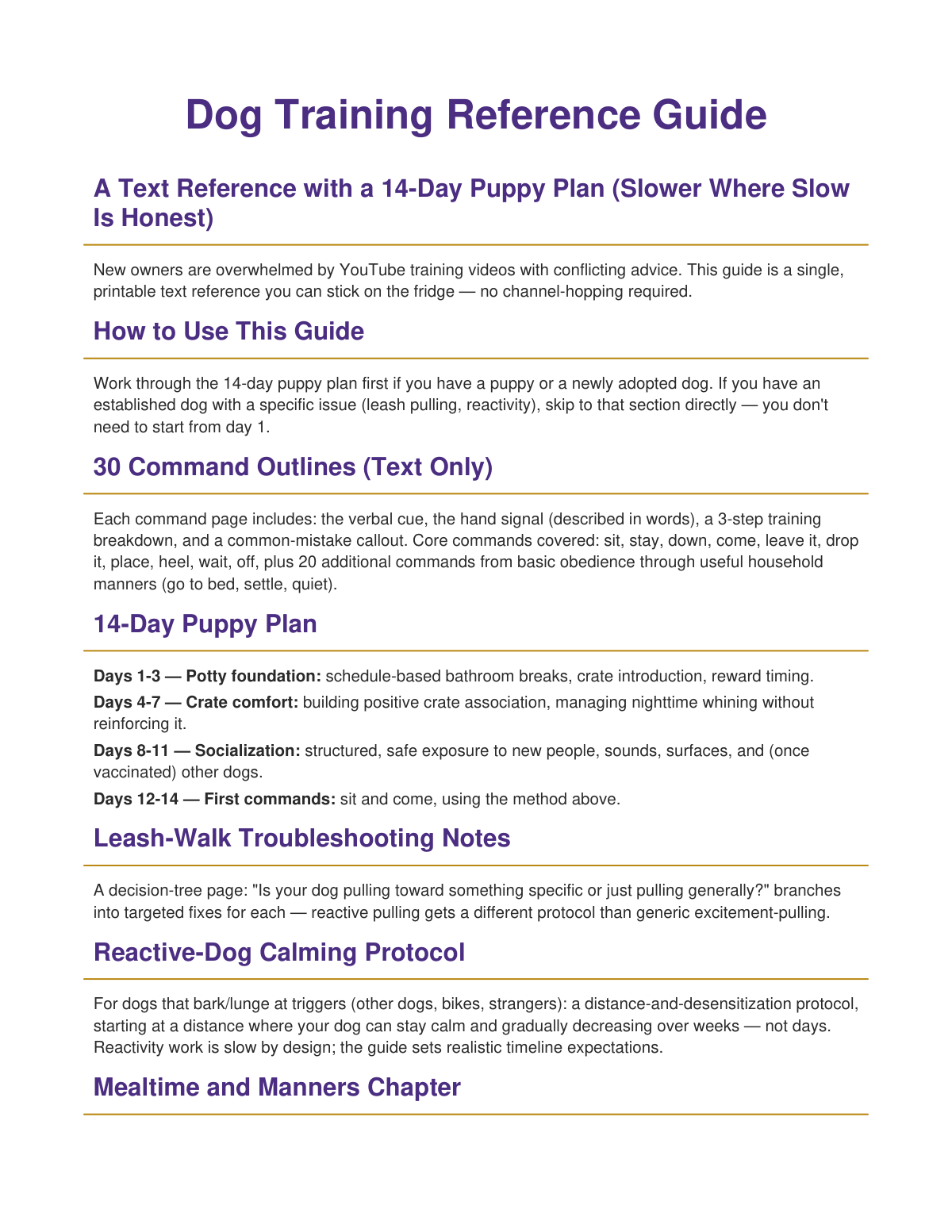
This guide includes a 14-day puppy plan that orders exactly that — early days focus on name recognition, settling, and routine, with obedience layered in as the pup succeeds. It is honest about pacing too: the protocol explicitly slows down where slow is honest, rather than promising a fully trained dog in two weeks. Any guide promising total transformation on a fixed deadline is selling fantasy.

Criterion two: troubleshooting for the real problems
Generic guides cover "sit" beautifully and go silent on the problems that actually drive owners to despair: leash pulling, reactive barking at other dogs, mealtime chaos, and vet-visit panic. Check the table of contents for these before buying.
Here you get 30 command outlines in plain text, plus dedicated sections on leash-walk troubleshooting, a reactive-dog calming protocol, mealtime manners, vet visit prep, and a common-mistakes summary. One honest note: this is a text reference — no illustrated pages are included — so visual learners should pair it with video for mechanics like leash handling.
Criterion three: humane methods and honest limits
Every modern veterinary and behavioral body favors positive reinforcement, and your guide should too. This one is explicitly a positive-reinforcement guide, and it states its boundary clearly: it is not a substitute for a certified trainer for aggression or significant fear cases. That disclaimer is a trust signal. Guides that claim to fix aggression with a PDF are dangerous; this one tells you when to call a professional.
On price and format realism: £15 lands slightly above the £15–£15 band of indie training ebooks, which is defensible only if the plan and protocols are genuinely complete — judge by the table of contents, not the cover. And remember this is a text reference, so budget a free video playlist alongside it for mechanics where seeing matters (leash grip, treat delivery speed, body positioning). The winning combination for most first-timers is this guide as the plan — what to teach, in what order, how to troubleshoot — plus short videos as the demonstration layer. Owners who pair a structured plan with visual demos consistently outperform owners who binge-watch random clips with no sequence, because training is a curriculum problem first and a technique problem second.
How this book helps
The Dog Training Reference Guide (£15, instant download) delivers the 30 command outlines, the 14-day puppy plan, leash and reactivity protocols, mealtime and vet-prep sections, and the mistakes summary as printable PDFs with a companion workbook.
A new puppy disrupts household routines as thoroughly as anything — the zone-cleaning system in The 15-Minute Zone Clean (ADHD Edition) keeps the house functional while you train. And if the puppy chaos has you dreaming of a calmer outdoor project, the Backyard Aquaponics Blueprint channels that DIY energy into a fish-and-vegetable build.
Related articles
2026-10-16 · 3 min read
How a 14-Day Puppy Plan Builds Obedience Without Overwhelm
Puppies learn fast and forget faster — which is why the structure of the first two weeks matters more than any single technique. The 14-day puppy plan…
Read article →2026-10-17 · 3 min read
How to Fix Leash Pulling and Reactive Barking With a Troubleshooting Routine
Leash pulling and reactive barking are the top two reasons owners call training "not working." Both are fixable with the same troubleshooting routine…
Read article →