2026-10-17 · 3 min read
How to Fix Leash Pulling and Reactive Barking With a Troubleshooting Routine
Leash pulling and reactive barking are the top two reasons owners call training "not working." Both are fixable with the same troubleshooting routine…
By AeternusVita
We make the products recommended here.
Leash pulling and reactive barking are the top two reasons owners call training "not working." Both are fixable with the same troubleshooting routine from the Dog Training Reference Guide: diagnose the trigger, change the setup, then retrain the moment. Here is how to run it.
Step one: diagnose before you train
Pulling has distinct causes with distinct fixes. Excitement pulling (lunging toward dogs, people, smells) needs impulse work. Fear pulling (dragging away, tail tucked) needs distance and confidence building. Equipment pulling (choking forward on a flat collar) needs a front-clip harness so physics stops rewarding the behavior. Spend one walk just observing: when does the pulling start, what is the body language, what happens right before?
Reactive barking gets the same diagnosis pass. Distance-reactive dogs bark at triggers beyond a threshold and can think below it; over-threshold dogs cannot learn anything until distance increases. Your key number is that threshold distance — the range at which your dog notices but can still respond to you. Every protocol that follows depends on knowing it.

Step two: change the setup, not just the dog
Management first. Walk at quieter hours, cross the street before the threshold, use a front-clip harness, and carry high-value rewards. Set up mealtime calm the guide's way: food delivered for settled behavior, not for spinning. Prep vet visits with short handling rehearsals at home (ears, paws, mouth) paired with treats, so the clinic is not the first time anyone touches the dog's feet.
Owners resist management because it feels like cheating. It is the opposite — it is preventing rehearsal of the problem while the new behavior gets installed. Every unpracticed lunge is progress.
Step three: retrain the moment with positive reinforcement
For pulling: the instant the leash tightens, stop or change direction; the instant it slackens, mark and reward. Sessions of five minutes beat marathons — practice on boring stretches before testing near the park. For reactivity: work at sub-threshold distance, reward calm noticing ("look at that" games), and increase difficulty in inches, not blocks. Log sessions in the workbook so you can see the threshold distance shrinking over weeks.
Know the boundary: genuine aggression or intense fear needs a certified trainer in person. The guide states this explicitly, and repeating it here matters — a PDF supports training; it does not replace professional eyes on a dangerous behavior.
How this book helps
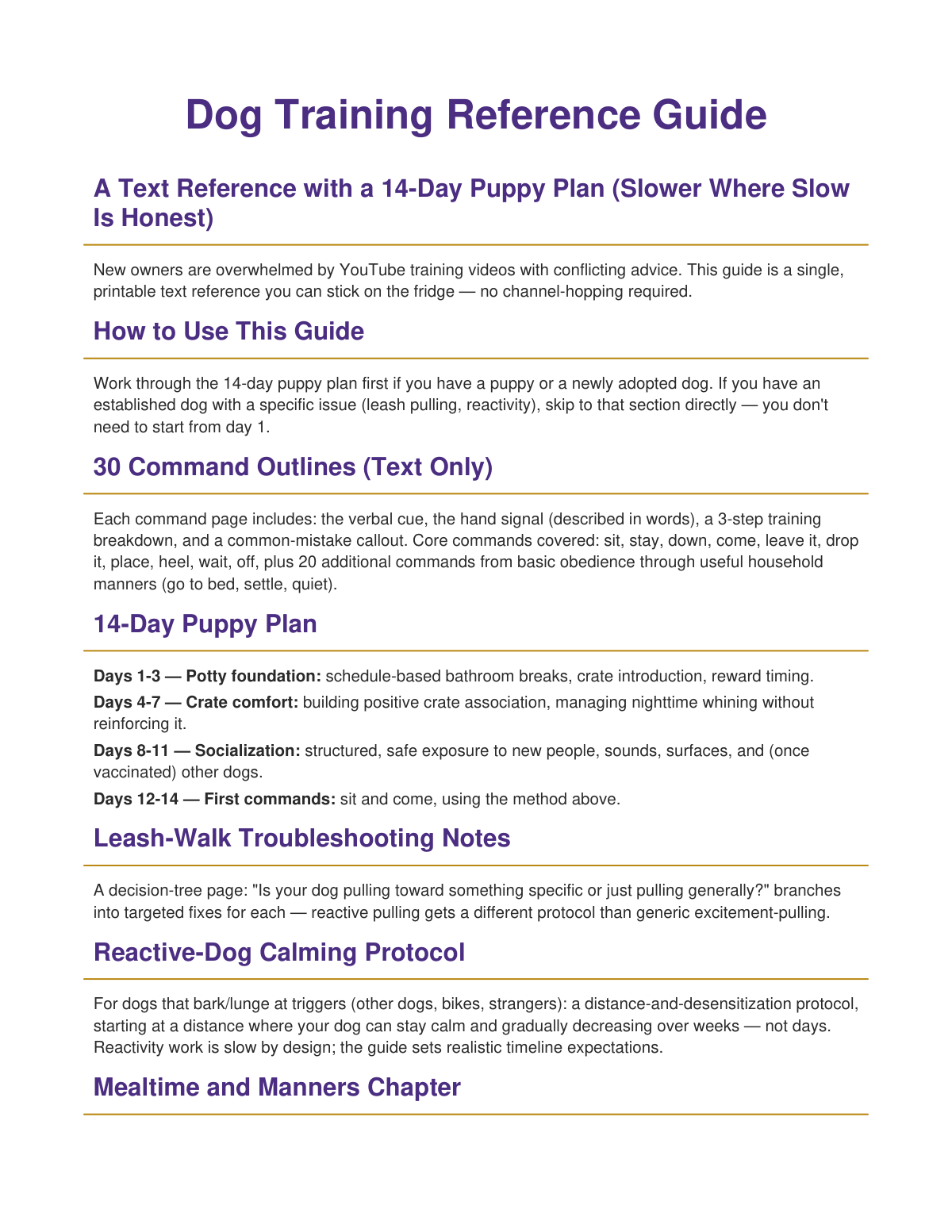
The Dog Training Reference Guide (£15, instant download) gives you the leash-walk troubleshooting notes, the reactive-dog calming protocol, mealtime manners, vet prep, all 30 command outlines, and the common-mistakes summary in printable form.
Training frustrations spill into household stress — Faith Over Fear: The Anxiety Workbook helps owners manage their own tension with scripture-based calming routines (calm handlers train calmer dogs). And the household-reset system in The 15-Minute Zone Clean (ADHD Edition) keeps muddy-paw chaos contained to one zone at a time.
Related articles
2026-10-16 · 3 min read
How a 14-Day Puppy Plan Builds Obedience Without Overwhelm
Puppies learn fast and forget faster — which is why the structure of the first two weeks matters more than any single technique. The 14-day puppy plan…
Read article →2026-10-15 · 3 min read
Best Puppy Training Guide for First-Time Owners: What to Look For
Bringing home your first puppy is joyful and slightly terrifying: the biting, the 3 a.m. whining, the leash that turns walks into wrestling. A good…
Read article →